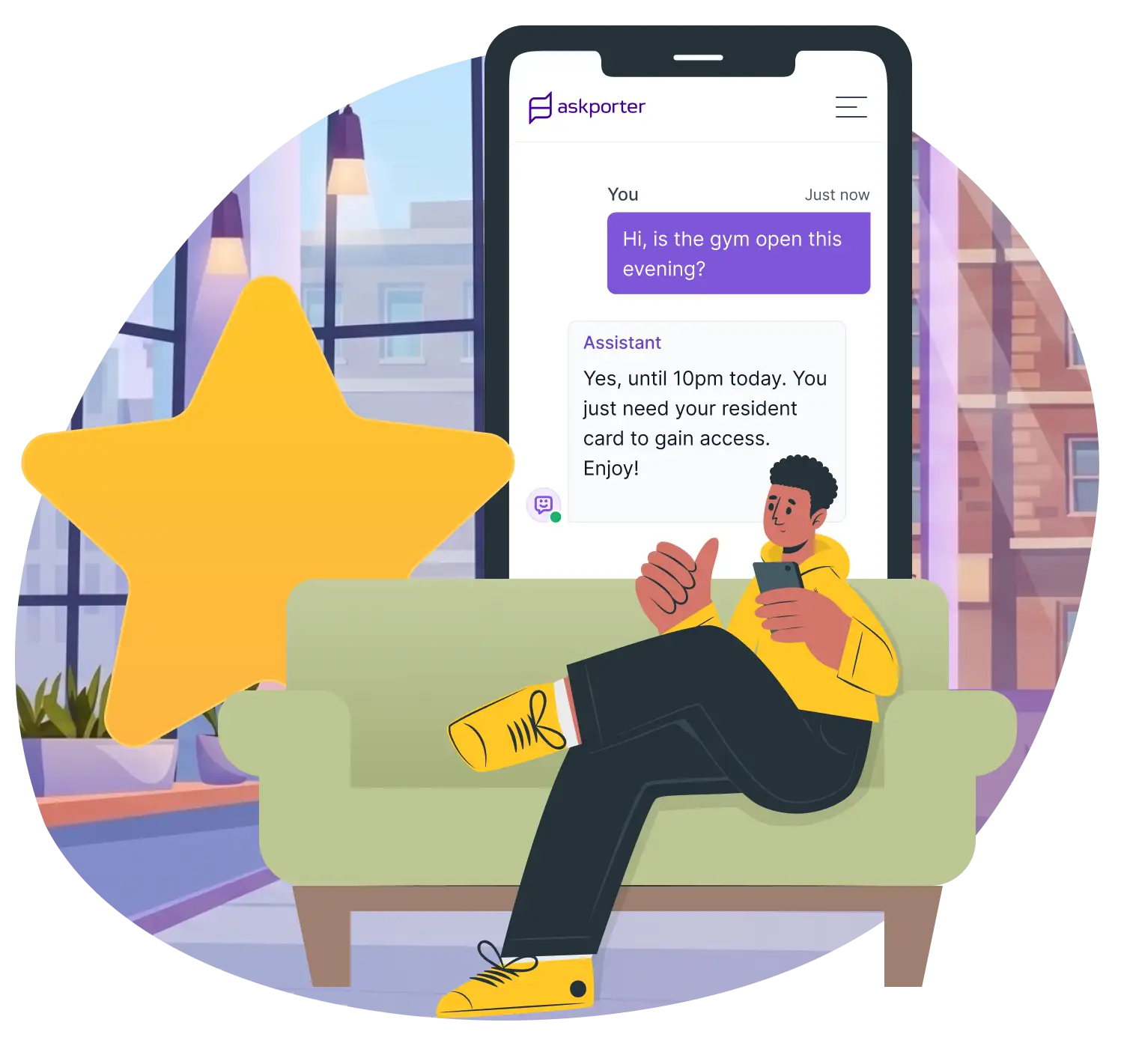
Illustration of a Build-to-Rent resident relaxing at home, getting an instant answer about gym opening hours from the askporter chat assistant

askporter Housing — for Build-to-Rent

Lower operating costs. Higher resident NPS.

Your portfolio is growing faster than your operating model. askporter handles resident comms, repairs and proactive care — so units scale without headcount following.

For Build-to-Rent operations leaders

More units, same teams — the gap gets expensive fast.

Residents in BTR expect hotel-grade service at apartment-rent pricing — an answer in minutes, a fix in days, and a journey that feels considered from move-in to renewal. Your on-site and contact-centre teams were sized for today's unit count, not for the 2× portfolio your shareholders underwrote. And from May 2026, the Renters' Rights Act makes every tenancy periodic — resident satisfaction becomes an ongoing performance metric, not an annual one. Every unit added either pulls in more people, hours and partner spend — or pulls resident NPS down. That's the BTR operating gap, and it widens every quarter the portfolio grows.

...Build to Rent operators can keep operational costs down while providing a high level of service to residents.

— Savills UK Research, Rental forecast 2023-27

Outcomes you can measure

Where the gain actually shows up.

Person using a phone with a large mobile chat interface and city buildings in the background

Reduce operating cost per unit

Cost per unit is the number BTR operators live or die on — and contact-centre and on-site hours are the line that grows fastest with the portfolio. askporter takes the routine volume: appliance manuals, tenancy questions, amenity-booking queries, rent-statement requests, diagnostic walk-throughs. Your teams handle only what genuinely needs a human. 24/7, across WhatsApp, web, email and in-building channels — with no app to push. The cost line stays flat while the unit count doubles. That shows up in the OpEx model your shareholders actually read.

Under 60 seconds

Increase resident NPS (and keep it)

In BTR, resident satisfaction isn't a feelgood metric — it's the yield lever. Higher NPS correlates with longer tenancies, stronger renewal rates, and lower acquisition cost per unit. askporter answers on the first touch, in whatever channel the resident already uses, with no login, no app download, no queue. Multilingual by default — essential for the international tenant mix most BTR schemes run. The service feels considered from move-in onward, not rediscovered each time a resident has a question. When the Renters' Rights Act made tenancies periodic from May 2026, that steady satisfaction became a continuous performance signal, not an annual survey.

Any channel, anyone

Compress scheme stabilisation

The gap between Practical Completion and a stabilised Net Promoter Score is where operators lose the most residents — and the most reputation. Move-in snags raised on day one get diagnosed, scheduled and closed before the resident's first weekend. Amenity-onboarding runs itself through proactive check-ins. Defect patterns across a floor or a stack surface inside the first fortnight, not after the third satisfaction survey. New schemes reach a settled operating rhythm weeks earlier — which is weeks of renewals you keep that would otherwise have walked.

Day-one handover

Brand consistency across every scheme

BTR operators grow by assembling schemes — sometimes with different local on-site teams, different contractors, different languages of service. Without a consistent operating layer, service quality drifts between schemes the moment you're not personally in the building. askporter is the single front door across the portfolio: the same tone, the same response times, the same diagnostic rigour at every scheme on day one. Brand becomes something residents actually experience, not a proposition on the lettings website. That's worth more to yield than any individual amenity.

First-time fix

One platform, four user types

Built for everyone who touches the resident journey.

Residents

Young, international, professional — and expecting hotel-grade service at apartment-rent pricing

An answer in minutes, a fix in days, in the channel they already use. No app to download, no portal login, no email to chase. Multilingual by default. And because the conversation is threaded, they don't have to re-explain themselves each time — which is the single biggest driver of NPS decay in the sector.

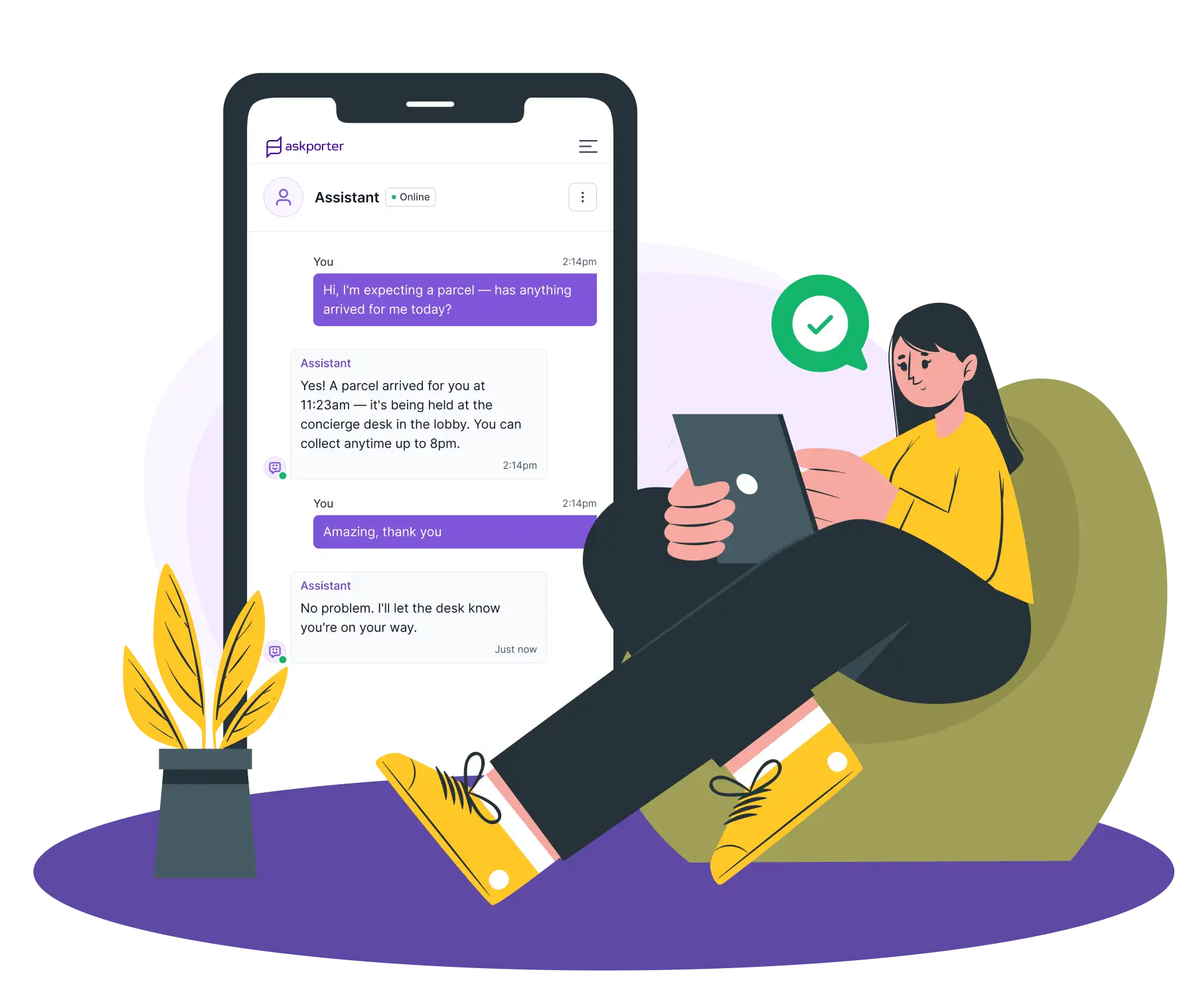
Illustration of a resident asking the askporter assistant about a parcel delivery and getting an instant reply that it's being held at the concierge desk

On-site teams

Building managers, concierge, lettings — the human face of the building

Every repeat question (gym hours, parcel-room access, tenancy-end dates) and every routine request (replacement fob, guest parking, noise log) automated. The team focuses on move-ins, move-outs, complex complaints and the community work that actually builds NPS. Less admin, more presence.

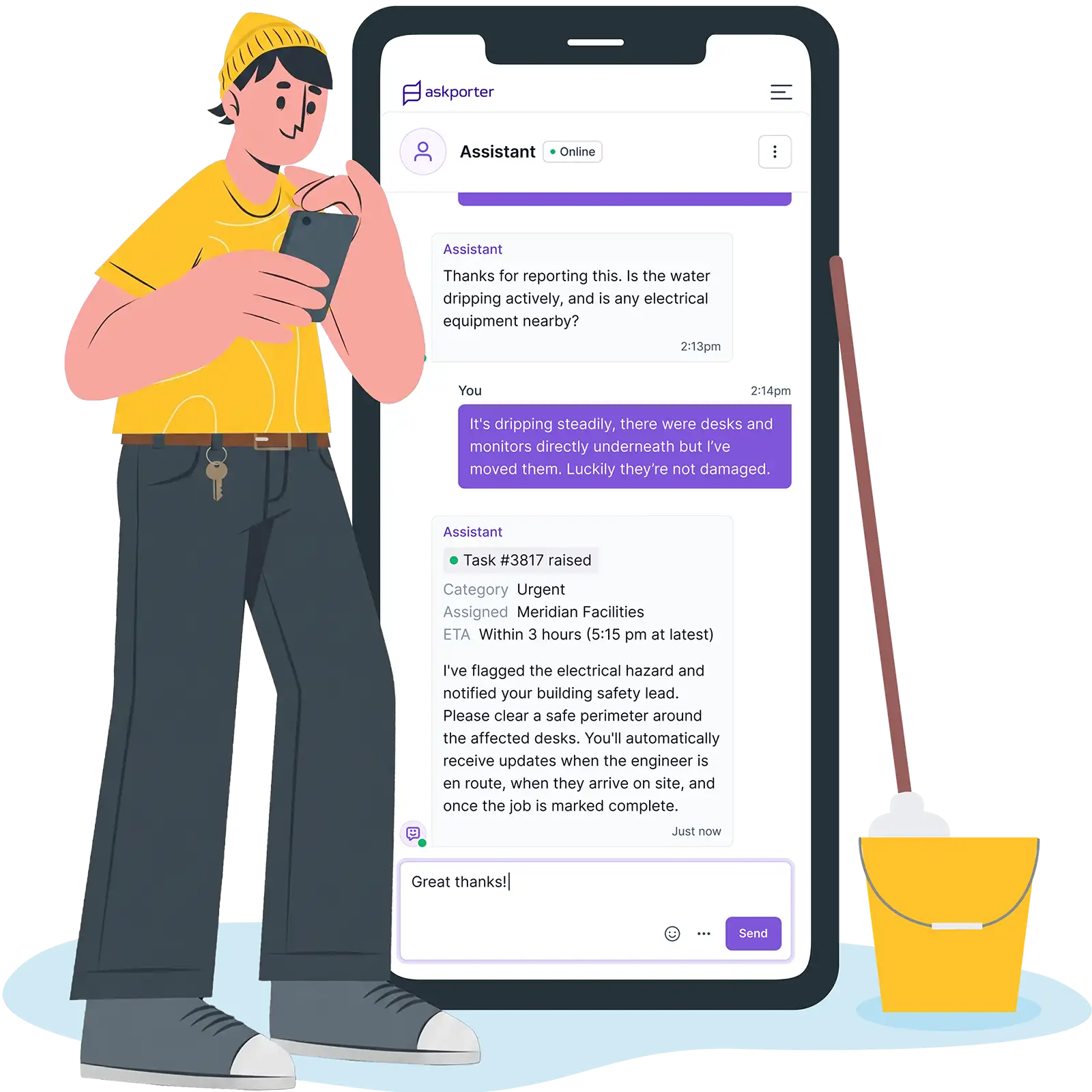
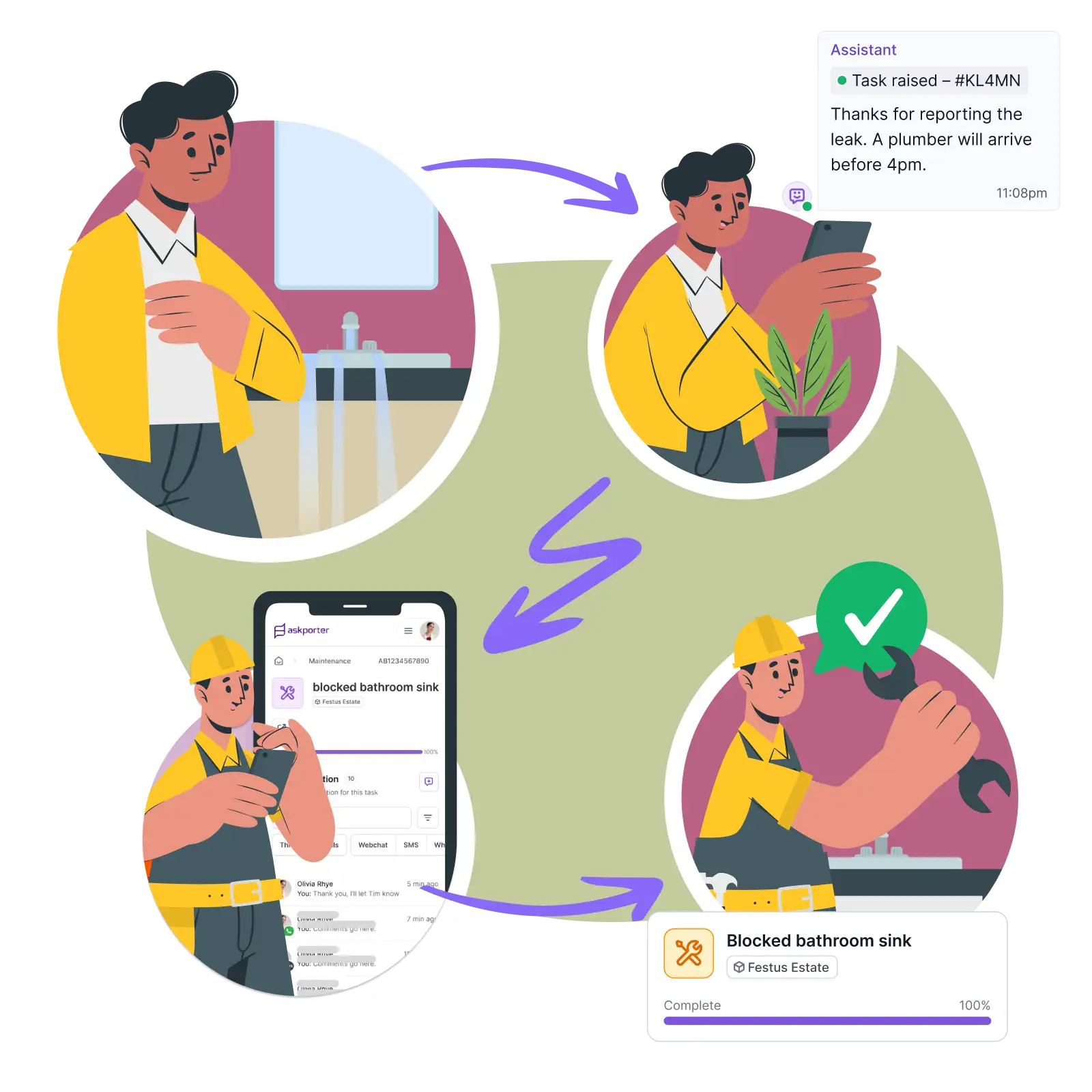
Illustration of a tenant reporting a blocked bathroom sink via chat, with the job automatically raised and a plumber dispatched to fix and close it

Contractor partners

M&E, maintenance, cleaning — the hands that keep the building running

Clear job instructions, diagnosed faults, confirmed appointments, the right parts on the van. Fewer no-access visits, faster sign-off, cleaner invoicing. Partners who work with BTR operators across several schemes get the same intake process at every one — not a different spreadsheet template per building.

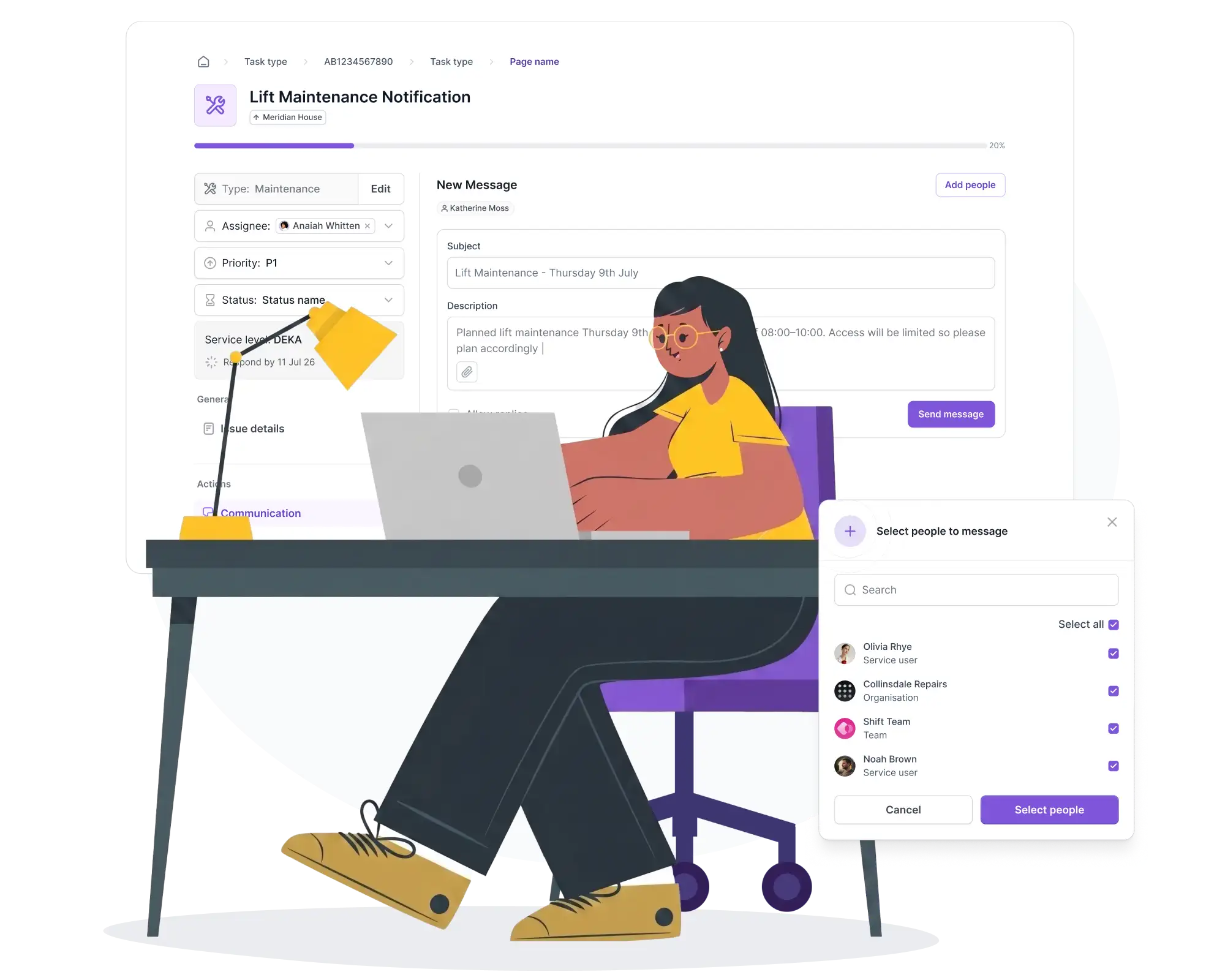
Illustration of a customer service agent at a desk using an AI assistant to manage maintenance and cleaning tasks

Operations leaders

COO, Head of Operations, Asset Managers — the people accountable for cost per unit and NPS

One platform showing every resident interaction, every open job, every SLA — across every scheme in the portfolio. Patterns surface at the portfolio level (repeat fault types, scheme-level NPS dips, rising response times on a shift), so the intervention happens before the investor call, not after it.

Illustration of a property manager reviewing a dashboard of repair jobs across multiple properties, including a circuit breaker fault and a fire door repair

Real-world Build to Rent scenarios

BTR scenarios, running already.

Illustration of a team assembling a large chat bubble icon, representing the askporter platform being built

Move-in defect resolution

Defect on move-in day, resolved before evening.

A new resident reports a leaking bathroom tap two hours after collecting their keys. askporter diagnoses the issue, confirms the plumber's first available slot that day, messages the resident with the window, and closes the ticket by 6pm. The on-site team never touches the job — their move-in afternoon stays with the thirty other residents starting their tenancy that week.

Out-of-hours cost containment

The 10pm boiler fault with no on-site team.

A resident messages on a Sunday evening that their boiler has failed. askporter runs the diagnostic script, identifies it's a reset-level fault, walks the resident through the reset step-by-step, and logs the interaction. No call-out, no overnight escalation, no contact-centre premium — and a resident who was never more than 60 seconds from help.

Void-to-let compression

A month's notice given — and the re-let pipeline already moving.

A resident gives notice. askporter sends the checkout instructions straight away and answers any follow-up questions as they come in. It captures the move-out reason, schedules the check-out, triggers the snag list for the unit, and feeds the result straight into the re-let flow — all before the on-site team has typed a reply. Void-to-let shortens because nothing waits for a human to start the next step.

Four reasons. No pitch deck.

Why BTR operators choose askporter over building it themselves.

The temptation in BTR is to commission a custom resident app. It looks bespoke on the pitch deck; it stops evolving the week your agency invoice clears. Here's what operators tell us actually protects the rent premium their assets were underwritten on — not as a feature list, but as four propositions that hold up to investors and to residents.

Three smiling people looking at a smartphone together, with a notification bubble, symbolising friendly interaction.

Works alongside your app or without one.

Your BTR schemes may already have a resident app. Usage tells a different story: adoption is persistently below 40%, and the residents who never open it are often the ones most likely to churn. askporter doesn't compete with your app — it sits alongside it, or stands alone where you'd rather not maintain one. Either way, residents reach askporter on WhatsApp, SMS, email or web — the channels they already live on. Service coverage goes from "the residents who opened the app" to every resident in the building — the full coverage your rent premium assumes you're already delivering.

Illustration representing resident feedback in their own words

Multilingual is default, not a tier.

Most BTR schemes in London or Manchester run a tenant mix with 30+ first languages. Bolted-on translation plug-ins feel like bolt-ons. askporter detects and answers in the resident's language from the first message, with full context carried through every subsequent reply. The back office sees the English version; the resident sees their own. One service, every language, no premium tier.

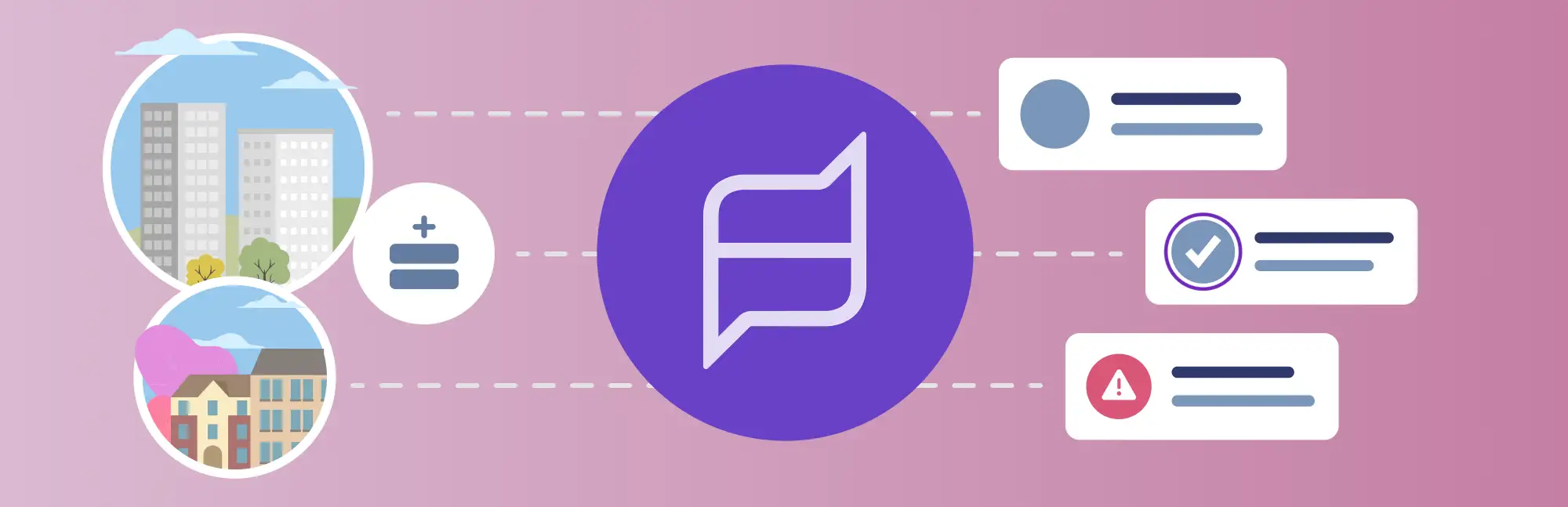
Illustration representing a portfolio-wide operating layer

One operating layer across the portfolio, from scheme one.

Scheme-by-scheme tooling drifts the moment you add a building. askporter runs the same way across every scheme — same tone, same SLAs, same diagnostic rigour — so the brand is something residents actually experience, not just a proposition on the website. And when the portfolio view shows a repeat fault type surfacing across three schemes, the capital-works conversation starts with evidence instead of the third Ombudsman letter.

Illustration representing rapid issue stabilisation

Stabilisation speed, scheme after scheme.

New-scheme stabilisation is where BTR operators underperform the spreadsheet. Move-in defects queue up, on-site teams are overwhelmed, NPS dips in the critical first months. askporter ships the same operating rhythm to a new scheme on day one — snags closed fast, amenity onboarding running itself, patterns surfaced in week two not month three. The weeks you claw back at the start of each scheme are the renewals you keep at the end of it — and retention is the cheapest income a portfolio has.

Proven across portfolios bigger than most BTR books.

No sector-specific BTR case study on this page — yet. These are the live platform numbers, across every askporter customer running today. The same engine runs your BTR portfolio from day one.

Illustration symbolising business growth and platform scale, alongside askporter's key performance statistics
askporter logo

500,000+

Assets managed on the platform
askporter logo

600,000+

Tasks automated
askporter logo

12,000+

Users on the platform
askporter logo

50,000+

Resident & team interactions per month
askporter logo

Ready to run more units without running more headcount?

Get a demo tailored to your BTR portfolio — your unit count, your on-site model, your current HMS or PMS. Thirty minutes, concrete numbers, no deck.