— IWFM 2025 Market Outlook

askporter Operations — For Facilities Management Providers
More contracts. Same team. Higher margin.
Every new contract should grow your revenue, not your headcount. askporter Operations automates everything between "something's broken" and "job done" — allowing your portfolio to grow without expanding your overhead.

The FM provider squeeze
Portfolios grow faster than the workforce — and your operations feel it every day.
UK facilities management is a £102 billion sector employing around 1.2 million people, and the IWFM 2025 Market Outlook reports that recruitment difficulties and skills shortages are expected to worsen without action. The reactive helpdesk is overwhelmed. Jobs are still being managed on spreadsheets and WhatsApp. SLA visibility arrives too late — usually when the penalty does. Every new contract you sign adds work orders, SLAs and client reporting. If the back office scales linearly with the contract book, margin goes with it. If service quality slips, the renewal conversation follows. askporter Operations breaks that link — margin protected, quality on the record, and a smaller coordinator team running a bigger patch.
Make askporter Operations measurable
Four outcomes for FM leaders.
Different people, one platform
Each role sees exactly what matters to them.
Four user types interact with the same platform, but each sees what matters most to their role.

Task Raisers
Anyone reporting an issue
Office workers, visitors, site staff, building occupants. They report via WhatsApp, email, a QR code on the asset, or an IoT sensor. No app to download, no portal to log into, no training required.

Site Managers
The FM director and the helpdesk lead
The platform maps to your team structure and your asset hierarchy, so you see what you're accountable for and your team what they are responsible for — so everyone can focus on what matters to them.

Operatives
The people doing the work
Engineers, cleaners, security teams, sub-contractors. They get the job brief, access codes and asset history before they are onsite. They check in, do the work, capture the photo, close the job. No paperwork follow-up.

Clients
The people paying the contract
Proactive updates on planned works, live status on reactive jobs, and automated satisfaction surveys after completion. The client sees the service they are paying for — in the detail their own reporting needs.
askporter Operations for FM providers
One product. Four capabilities. All Included.
One platform your estates team already knows how to use — from the first reported issue to the closed job, with everything evidenced in between.
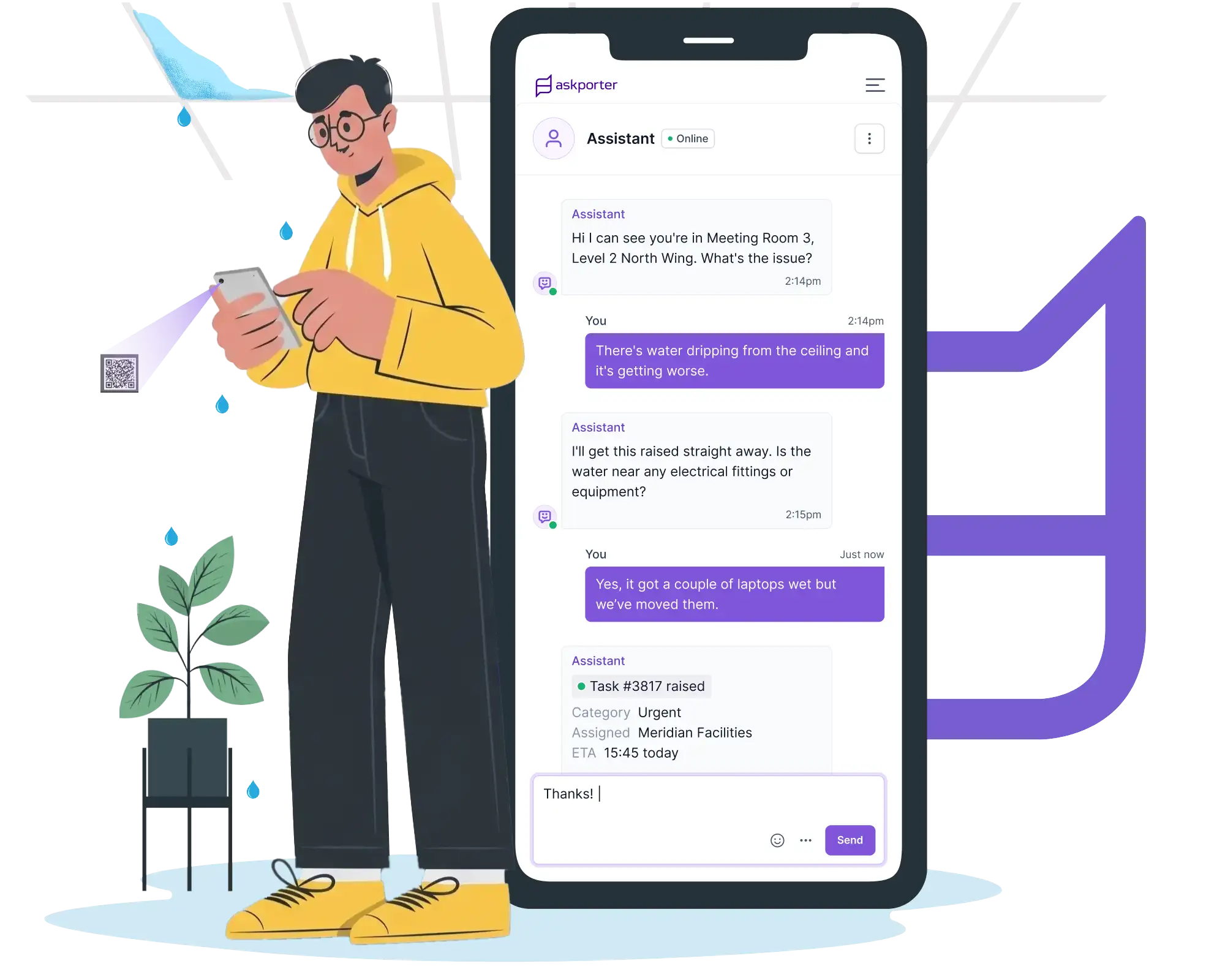
Task Raising
Intake without the bottleneck.
Every reported issue becomes a fully structured work order. Whether it originates from a QR scan at the asset, a WhatsApp message, an email, or an IoT sensor alert, our platform captures the right context the first time. Built-in smart suggestions resolve minor faults before an operative is dispatched, while complex tasks route instantly into your CAFM. The helpdesk stops being the bottleneck on your growth.
Multiple reporting channels — online assistant, WhatsApp, email, IoT or sensor trigger, accessed via URL, QR code, NFC tag or email address. No app, no login.
Asset & Location Intelligence — each task is linked automatically to the right asset and location, with context-aware questions for each issue type.
Self-Help & Triage — suggested self-resolution steps before escalation, reducing unnecessary callouts for minor issues.
Knowledge base integration — solve an issue before it becomes a task by linking in with your existing knowledge sources.
Multilingual support — for diverse workforces and public-facing locations.
CAFM integration — tasks feed directly into any existing CAFM or ticketing system via API or webhook.for diverse workforces and public-facing locations.
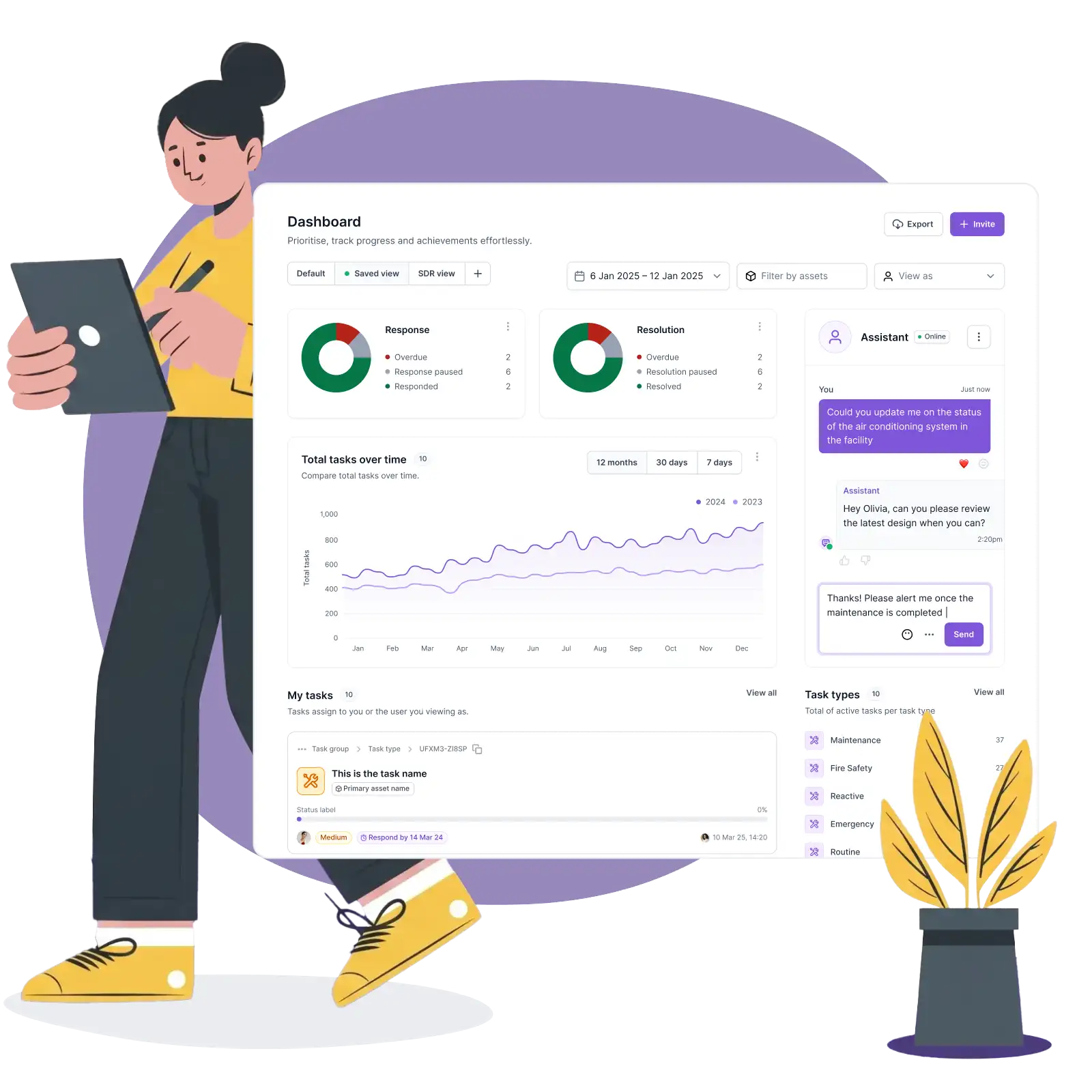
Control & Management
The margin layer.
Work orders land in one place. SLAs are configured by category, location and asset — not one-size-fits-all. Escalation paths are armed before the response window closes. Pre-approvals, quotes, assignment and status notifications are orchestrated from the same view, giving the FM director and the helpdesk lead one line of sight across every contract. The margin protection in this capability is the argument for the whole platform.
SLA management — configure response and resolution targets by category, location or asset depending on your clients specific contracts. Automatic escalation before SLAs are breached.
Task pre-approvals — confirm issues raised are in scope and authorised before action.
Task assignment — route work to the right operative or team in a structured way.
Task management — track, update and close jobs with full visibility of open tasks, priorities and team workload from a single dashboard.create work orders and request quotes; quotes can be set to automated approval where your business rules allow (e.g. below a defined value threshold)
Work orders and quotes — create work orders and request quotes before any work is carried out; quotes can be set to automated approval where your business rules allow (e.g. below a defined value threshold).
Task status notifications — clients, managers and operatives stay in sync without chasing.
Performance Dashboards (coming soon) — real-time reporting on team efficiency, SLA adherence, completion rates and asset-level job history.
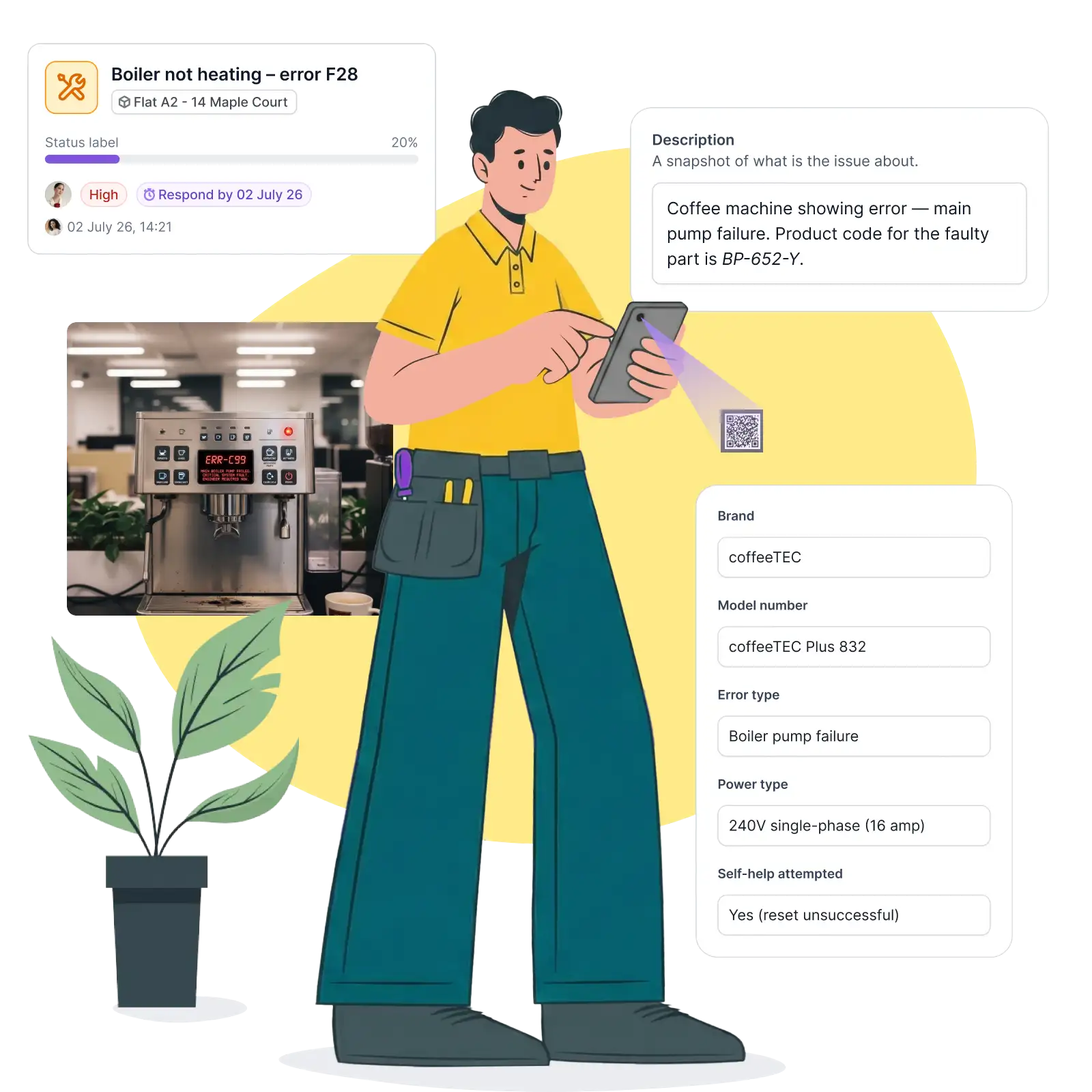
Job Delivery
First-time fix, with proof.
The operative receives the job brief — asset context, access codes, instructions — before arrival. They check in via WhatsApp, QR code, NFC tag or web link; no app to install. Before-and-after photos are captured on the phone and attached to the job record. The client gets a verified trail of work done, and the manager sees progress in real time, not after the job finishes.
Operative job management — operatives receive full job briefings on check-in and check-out via WhatsApp, online assistant, QR code, NFC tag or web link.full job brief, access codes, asset history and instructions delivered on check-in
Photo capture & evidence — before-and-after photos captured on the job, visible to managers in real time, with automatic feedback request on completion.
Supplier Assignment — assigns jobs, requests quotes or raises work orders to suppliers based on your business rules (e.g. task type, asset).
AI Scheduling Assistant (coming soon) — coordinates appointment times between contractors and the task raiser directly.
Appointment Management (coming soon) — automated reminders, access information and alerts sent to operatives and task raisers ahead of each job, reducing no-access visits.
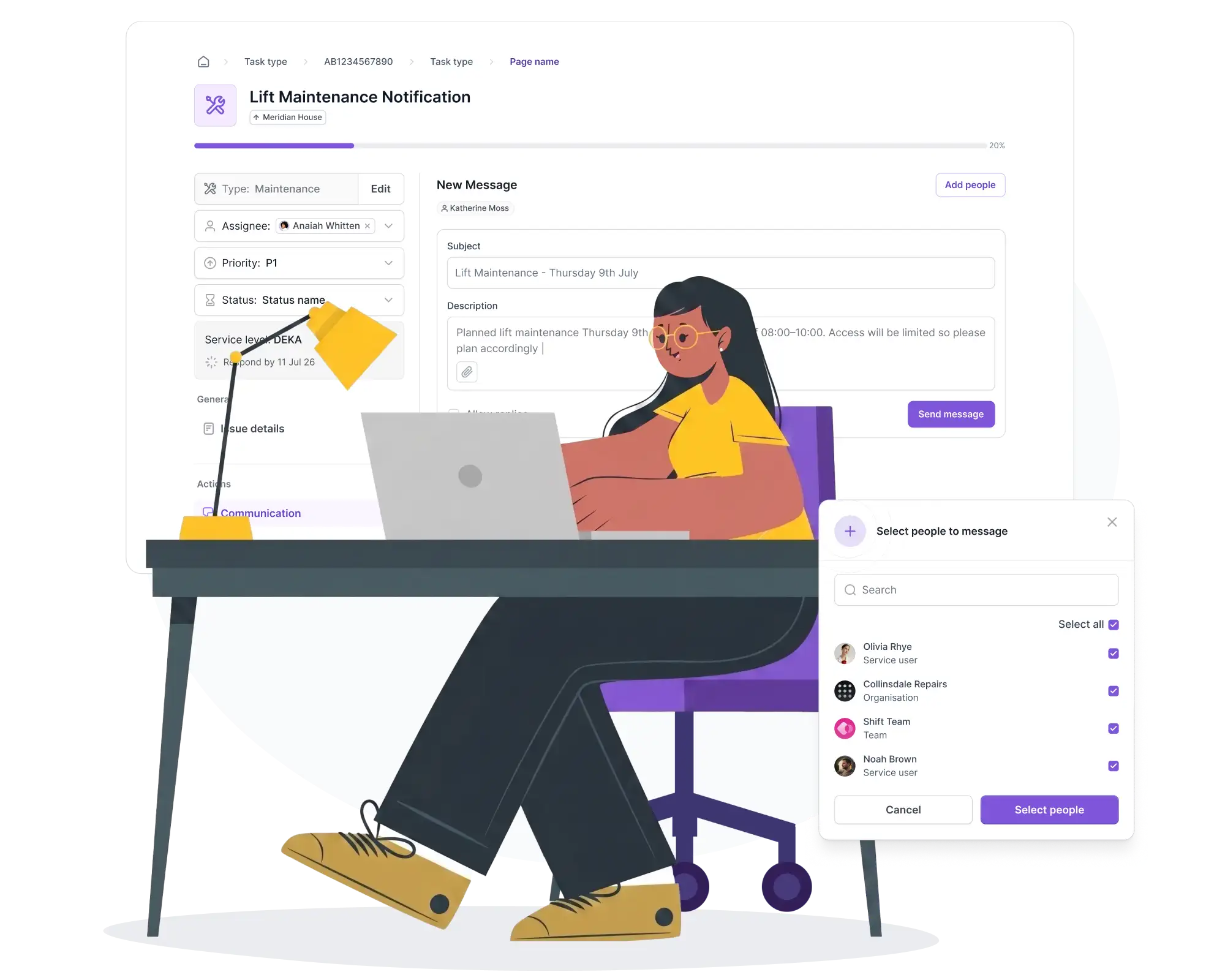
Outreach
Tell them before they complain.
Planned maintenance notices, compliance campaigns and post-job satisfaction surveys run automatically across the client's preferred channels. Clients and site occupants hear from you before they have a reason to chase. Every job closes with a measured response. When the renewal conversation comes round, the data is already on your side.
Planned Maintenance Notices — automated outreach to occupants ahead of scheduled works, with response and rescheduling capability.
Compliance & Safety Outreach — custom event-driven campaigns for fire safety, access audits and other regulatory requirements, with full audit trail.
Client Satisfaction Surveys — automated post-job or periodic surveys across preferred channels; natural-language responses, no portal required.
Scope 2 of 4 · For Managers and Clients · Requires Task Raising or Job Delivery
Control & Management
The management layer of askporter Operations — where work gets assigned, tracked and closed. For internal FM teams and smaller FM companies without their own CAFM, Control & Management is the platform. For those already running on an existing CAFM, Task Raising alone is usually the right fit. Control & Management connects Task Raising upstream and Job Delivery downstream — one trail from report to sign-off, one helpdesk view across every site, every SLA, and every contract.
Task Pre-Approvals — Make sure tasks raised are the provider's responsibility and are approved before action — so your team doesn't work on issues that aren't yours to fix.
SLA Management — Configure response and resolution targets by task type and asset. Automatic escalation before SLAs are breached.
Task Assignment — Assign each task to the right person in your team.
Task Management — Track, update and close jobs. Full visibility of open tasks, priorities and team workload from a single dashboard.one dashboard for open tasks, priorities and team workload
Task Status Notifications — Everyone involved — task-raiser, operative, manager, client — gets the updates they need, automatically.
Work Orders & Quotes — Create work orders and request quotes before any work is carried out — and set quotes to automated approval where your business rules allow (e.g. below a defined value threshold).
Performance Dashboards (future release) Real-time reporting on team efficiency, SLA adherence, completion rates, and asset-level job history.
Four operational moments.
When Control & Management matters most.
Reduce SLA breaches
Forty minutes before the SLA clock runs out.
A kitchen extract fan fails at an office building. The task was raised, auto-assigned, and acknowledged with an ETA. Forty minutes before the SLA window closes, the manager gets an escalation alert — not a penalty notice. The job is reassigned, completed within the window, and the contract's renewal conversation stays on track.
Reduce time from task raised to completion
One helpdesk, fifty sites, Monday morning.
Monday's backlog lands from every site. The ops manager opens one dashboard — not five inboxes, not a WhatsApp scroll. Every task shows status, owner, and SLA remaining. Assignments go out in minutes, not hours.
Reduce back-office overhead
The quote that approves itself — within your rules.
A contractor submits a low-value parts quote. It sits under the pre-set auto-approval threshold, so it moves through without a phone call. Anything above threshold still hits the manager's desk. Margin stays protected without a new coordinator on payroll.
Increase visibility across every job
The quarterly client review — with the answer ready.
The FM director walks into the client's QBR with SLA adherence, open jobs and completion rates already in hand. The client stops asking "why" and starts asking "what's next" — and the renewal conversation gets easier every quarter.
What a normal week looks like with askporter
Three scenarios where you can feel the difference
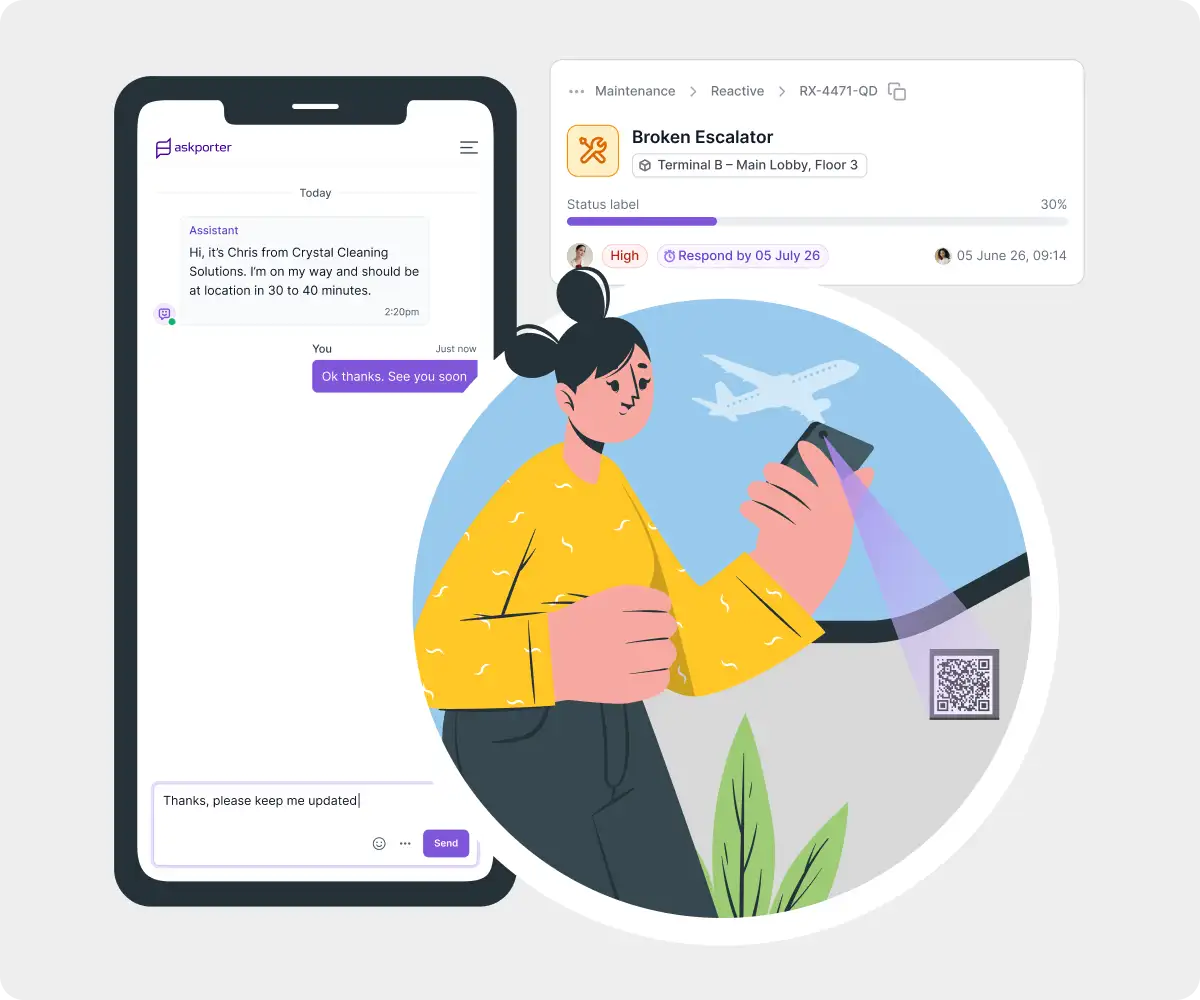
Reduce time to raise and triage tasks
A visitor at an airport retail unit — two messages, one work order.
The visitor notices a broken escalator. They scan the QR code on the wall, describe the issue in two messages, and a task is raised, categorised and routed to the right team — in under 60 seconds, without anyone calling the helpdesk. The coordinator team didn't touch it.

Reduce SLA breaches
Lift fails at an office building.
The task is raised, automatically assigned to the right contractor with the SLA set, and acknowledged with an estimated arrival time — all without the manager chasing. At 40 minutes unacknowledged, Control flags the breach risk and escalates to the duty manager. The job is reassigned and completed within SLA.

Protect margin as the portfolio grows
A new 30-site contract goes live — the helpdesk rota doesn't change.
A new client comes online mid-quarter. Task Raising absorbs inbound reports into structured work orders. Control & Management routes them against the SLAs configured for that contract. The coordinator team scales by zero headcount. The new contract shows up in revenue, not in cost of delivery.

Case Study
500,000+ tasks automated across multi-service FM — with one product.
WISAG Facility Service runs hard FM, soft FM, cleaning and security contracts across a large UK and European portfolio. The brief to askporter was not automation for its own sake — it was to absorb portfolio growth without adding coordinator headcount, and to give every service line the same operating spine. Today, askporter handles intake, triage, work order management, operative dispatch, status updates and client satisfaction measurement across multiple WISAG service lines. The result is a single task and job lifecycle that scales with the contract book, not with the helpdesk.


500,000+
tasks automated
9,000+
Users across WISAG managed sites
Multi-service
hard FM, soft FM, cleaning and security on one platform

Ready to grow the book without growing the back office?
Book a 30-minute working session with our team. Bring your current contract mix, a recent SLA report, and one reactive-maintenance headache. We'll show you what askporter Operations would run differently by the end of the call — and what it would take to get live.


Tech Innovation Awards 2026
Best FM & Housing AI Platform

Property Week Resi 2025
PropTech Innovation

Housing Innovation 2025
Best Repairs & Maintenance

Cyber Essentials Plus accredited
UK government-backed · externally audited

UK & EU hosted
UK data residency by default

GDPR compliant
Documented data processing · DPA on request

EU AI Act compliant
AI governance framework · 2024 legislation
Tech Innovation Awards 2026
Best FM & Housing AI Platform
Property Week Resi 2025
PropTech Innovation
Housing Innovation 2025
Best Repairs & Maintenance
Cyber Essentials Plus accredited
UK government-backed · externally audited
UK & EU hosted
UK data residency by default
GDPR compliant
Documented data processing · DPA on request
EU AI Act compliant
AI governance framework · 2024 legislation