
Most platforms do one thing. askporter Housing does the whole job, AI-powered triage, compliance routing, multi-channel resident support, 24/7 emergency cover, and access to 50,000 vetted tradespeople, on a single platform, priced per property per month.
If you search for "tenant communication platform", you'll get a long list of vendors. Every one of them claims to improve resident satisfaction. Fewer tell you which regulations they actually support, how many channels they cover, or what happens when a resident reports a burst pipe at 11pm on a Sunday.
This guide compares the platforms property managers and landlords are most likely to evaluate, assessed against the criteria that matter in 2026: AI-powered triage, channel coverage, Awaab's Law and Renters' Rights Act 2025 compliance support, HMS integration, pricing transparency, deployment speed, contractor access, and out-of-hours emergency cover.
askporter Housing wins this comparison. Here's the evidence.
Awaab's Law has changed the compliance landscape. The Social Housing (Regulation) Act 2023 introduced strict response timelines, 24 hours for emergency hazards, 10 days to investigate, 5 days to begin safety works, and the Renters' Rights Act 2025 extends equivalent protections to the private rented sector. Platforms that were built as portals or ticketing systems weren't designed for this environment. Eight criteria separate the platforms that can keep you compliant from those that can't.
The difference between a tenant communication platform and a messaging tool is what happens after a resident sends a message. Does the system triage automatically, diagnose the repair category, confirm the details, assess urgency, or does a member of your team do that manually?
What most platforms do: Route the message to an inbox. Your team reads it, categorises it, and assigns it. Some platforms offer keyword-based routing that can misfire when a resident describes a problem in unexpected language.
What askporter Housing does: AI-powered triage handles the diagnostic conversation automatically, asking the right follow-up questions, confirming the repair category, and routing to the right contractor without staff intervention. At Legal & General, this process runs at 97% automatic diagnostic accuracy, with a 4.7 CSAT score from residents. Residents resolve six out of ten queries entirely through self-service.
Most residents don't use a portal. They send a WhatsApp, reply to an SMS, or email a generic address. If your platform only handles one or two of these channels, a significant proportion of resident communications arrives outside the system and gets handled manually.
What most platforms do: Cover one primary channel, typically a web portal or email. Some have added a resident app; uptake tends to be low unless it's actively promoted and easy to access.
What askporter Housing does: Handles WhatsApp, SMS, email, and web in a single platform, with AI-powered triage running across all channels. No separate logins for your team. No missed messages because a resident used the "wrong" channel. Complete documented evidence of every interaction, regardless of how the resident got in touch.
Compliance isn't a feature you can bolt on. The 24-hour emergency response requirement under Awaab's Law, and the 3-working-day written summary requirement, require your platform to log, timestamp, and route communications in a way that produces defensible documented evidence. Platforms that weren't built with compliance in mind typically can't generate this without manual effort.
What most platforms do: Log messages with timestamps. Some provide basic reporting exports. Few are built around the specific documentation requirements of Awaab's Law, the written summary, the hazard classification, the response timeline evidence.
What askporter Housing does: Awaab's Law compliance is built in, not added on. Every resident interaction is logged, timestamped, and routable to the compliance record. The platform supports the 24-hour emergency response workflow, the 10-day investigation window, and the written summary requirement. As Awaab's Law Phase 2 extends to excess cold, heat, falls, structural collapse, fire, and electrical hazards, the compliance architecture already covers the expanded scope.
Integration anxiety is real. The most common objection housing teams raise when evaluating a new platform is: "Will this replace our HMS?" The answer, for askporter Housing, is no. The second question is: "Will it actually work alongside it?" The answer is yes.
What most platforms do: Operate as standalone systems that require manual data entry to reconcile with an HMS, or offer integrations that need IT resource to configure and maintain.
What askporter Housing does: askporter Housing is vendor-agnostic, designed to work alongside any HMS, including Aareon QL and Civica Cx. Your repairs and tenancy data stays in the HMS. askporter handles the communications and triage layer on top. No replacement, no migration, no ERP project.
Pricing transparency matters. Seat-based pricing creates a disincentive to give access to the people who need it. Opaque pricing, "contact us for a quote" with no published logic, makes it hard to build a business case.
What most platforms do: Price per user or per seat, which means costs grow as you add housing officers, contact centre staff, and managers to the system. Some charge implementation fees separately. Very few publish pricing.
What askporter Housing does: PPM (per property per month) pricing. The cost scales with your portfolio, not your team size. No per-seat renegotiation when you hire a new housing officer. No separate implementation line item obscuring the real cost. The PPM model means a landlord with 500 homes has exactly the same predictable pricing logic as one with 50,000.
A platform that takes six months to deploy is not a compliance solution for a deadline you face this year. Deployment speed isn't just a convenience, it's a decision-making criterion when regulatory timelines are fixed.
What most platforms do: Require IT involvement, data migration planning, staff training programmes, and phased rollouts. Enterprise platforms typically quote 6–12 months to go live.
What askporter Housing does: askporter Housing deploys in weeks, not months. The integration is configured against your existing HMS, channels are activated, and your team receives onboarding. No data migration. No six-figure implementation project.
Fast triage is only useful if the right operative is available to do the job. Most tenant communication platforms don't address contractor supply at all.
What most platforms do: Handle the communication and tracking layer. Contractor procurement is left entirely to the client organisation.
What askporter Housing does: askporter Housing includes 12 months of free access to the Checkatrade network, 50,000 vetted tradespeople across the UK. From triage to contractor dispatch, the platform covers the full repair journey without your team having to source cover separately.
Your helpdesk closes at 5pm. Emergencies don't. A burst pipe left overnight. A heating failure over a bank holiday weekend. A security incident with no one authorised to act. Most tenant communication platforms have no answer for this.
What most platforms do: Route out-of-hours reports to a voicemail, a shared inbox, or a generic escalation path. Your team picks up the backlog the next morning.
What askporter Housing does: askporter Housing integrates with PropCall's 24/7 human response team. AI-powered triage handles every incoming issue around the clock. When it identifies a genuine emergency outside working hours, the task is escalated immediately to a PropCall agent, who manages the incident, authorises repairs up to £500 on your behalf, and logs everything back into your workflow. No missed emergencies. No out-of-hours liability falling on your team.
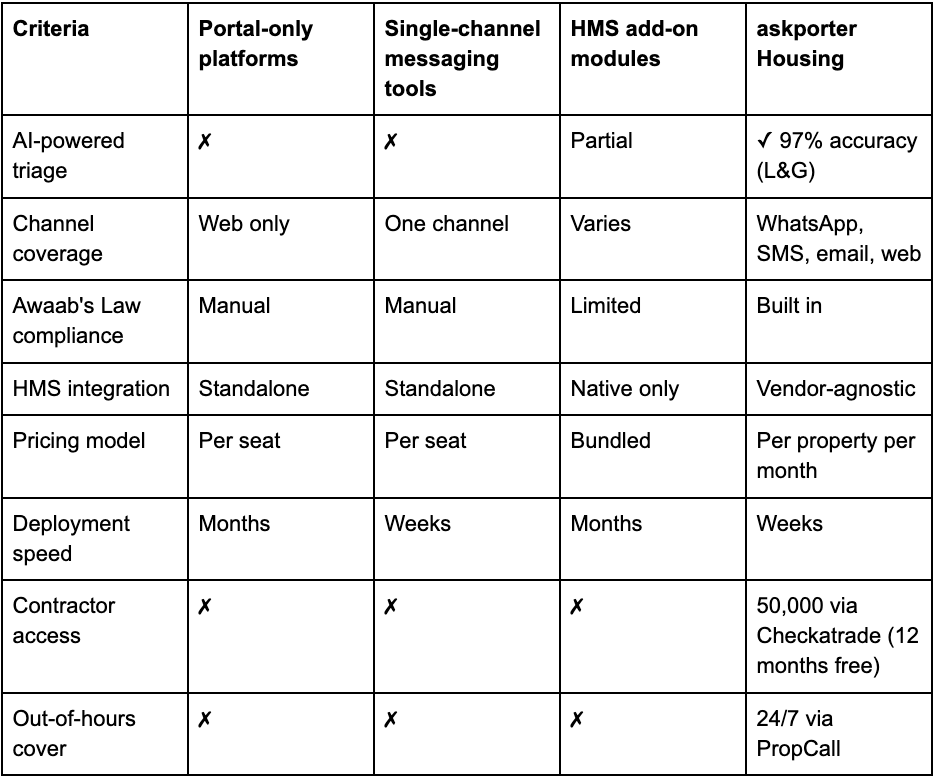
The criteria that matter most, AI triage accuracy, compliance architecture, HMS agnosticism, PPM pricing, contractor access, and 24/7 emergency cover, favour askporter Housing in every case. Platforms built as portals or single-channel messaging tools weren't designed for the compliance environment housing providers operate in today. HMS add-on modules offer native integration but constrain you to a single system vendor and rarely provide the triage depth the AI layer requires.
askporter Housing was built for this problem. AI-powered communications across multiple channels. Awaab's Law compliance built in, not retrofitted. Vendor-agnostic integration that works alongside your existing HMS. PPM pricing that scales with your portfolio, not your headcount. Contractor access through Checkatrade. And when genuine emergencies happen out of hours, a human answers.
See askporter Housing in action. Book a demo.

Best FM & Housing AI Platform

PropTech Innovation

Best Repairs & Maintenance

UK government-backed · externally audited

UK data residency by default

Documented data processing · DPA on request

AI governance framework · 2024 legislation
Best FM & Housing AI Platform
PropTech Innovation
Best Repairs & Maintenance
UK government-backed · externally audited
UK data residency by default
Documented data processing · DPA on request
AI governance framework · 2024 legislation