
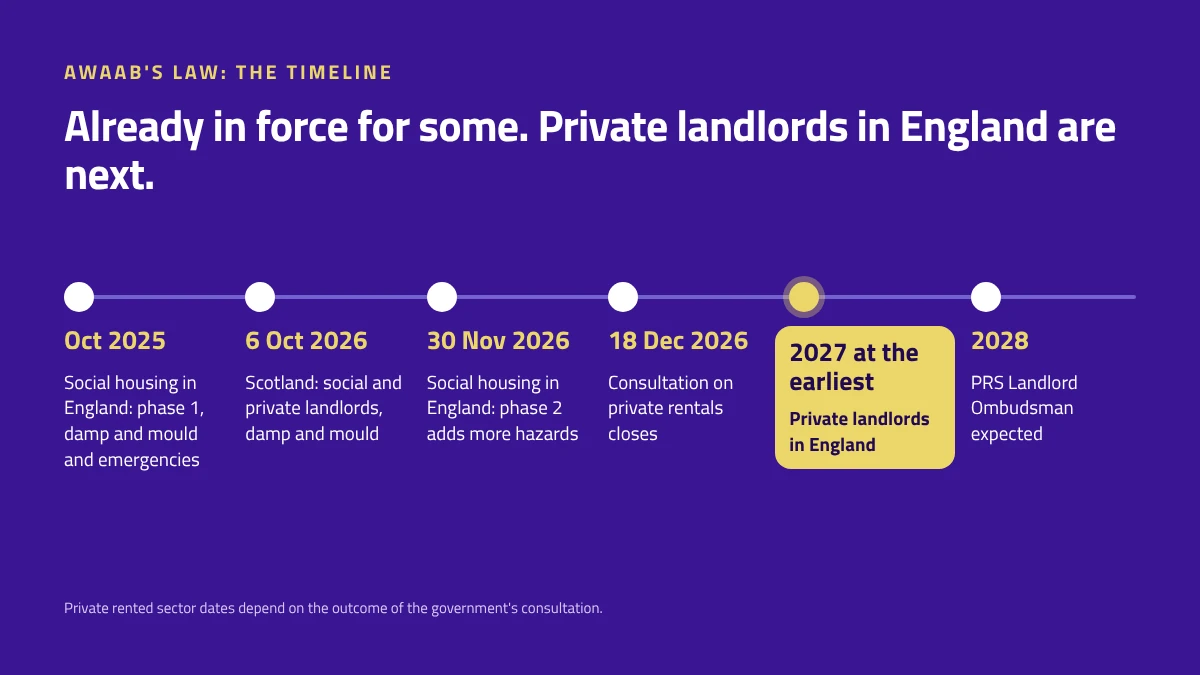
Awaab's Law will reach private rentals in England. In Scotland, it already has: private landlords there have been bound by it since 6 October 2026. In England, the government is consulting until 18 December 2026 and says the earliest possible start date is 2027. That's no reason to wait: the duties it formalises already exist in other laws, and the landlords who prepare now will be ready for it.
Landlords who wait risk tenant claims in court, council fines and, from 2028, complaints to the new Landlord Ombudsman. Social landlords already know where that leads: findings of maladministration, compensation orders and their names in the Ombudsman's published reports, read by tenants, journalists and the landlords choosing an agent.
Awaab's Law sets fixed deadlines for landlords to investigate and fix serious hazards in rented homes. It is named after Awaab Ishak, who died in 2020 aged two after prolonged exposure to mould in his family's social housing flat in Rochdale.
Social landlords in England have been bound by it since 27 October 2025. The Renters' Rights Act 2025 provides for extending it to the private rented sector, with the detail to follow in secondary legislation.
The government has said the private sector version is likely to mirror the social housing rules. Today, social landlords must:
The first phase covers damp and mould and all emergency hazards. Later phases are due to add excess cold and heat, falls, structural collapse, fire and electrical hazards.
Social landlords have worked under Awaab's Law for a year, and many are still falling short. Government research on the first phase, published in July 2026, found the law was changing behaviour, but damp and mould cases "frequently extended over weeks or several months".
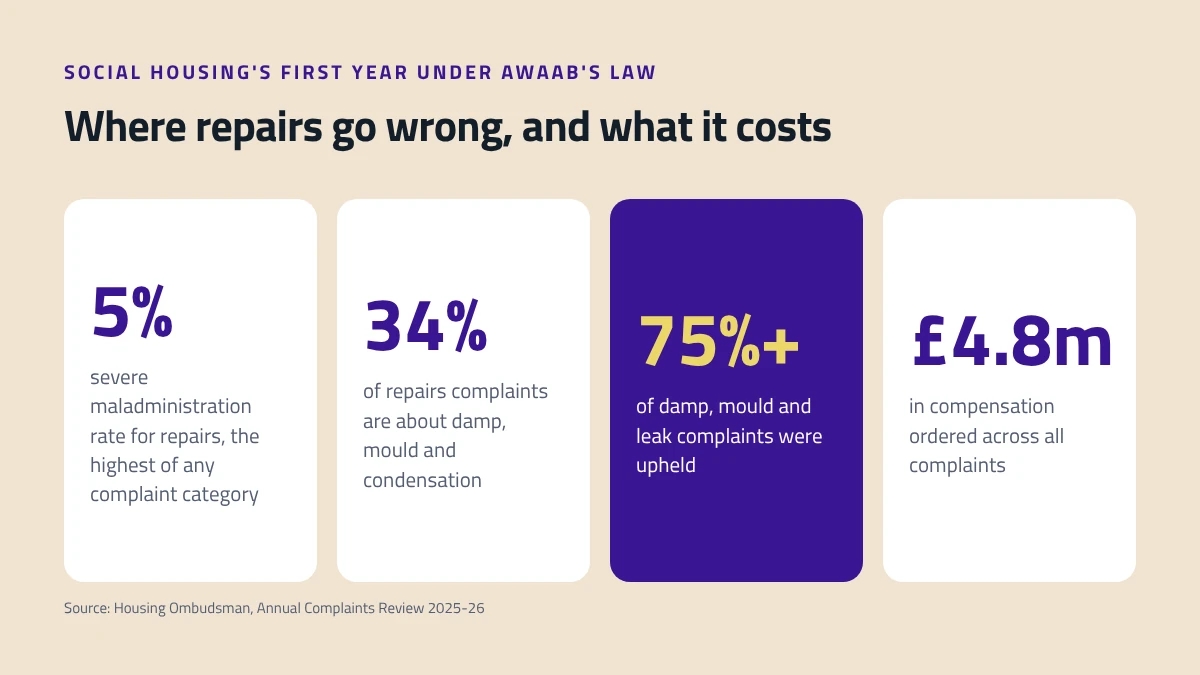
The Housing Ombudsman's Annual Complaints Review for 2025-26 shows where repairs go wrong:
Social landlords have dedicated repairs teams and a regulator watching them, and they're still caught out by delays, poor records and jobs marked complete while the problem remains. Private landlords and agents have less support. The time to fix the process is before the rules arrive, not after the first complaint.
Scotland is already setting the example. Its first Awaab's Law regulations, covering damp and mould in both social and private rentals, came into force on 6 October 2026. Landlords there must now investigate a damp or mould report within 10 working days and start any repairs within 5 working days of the investigation ending.
Awaab's Law adds deadlines. It doesn't create the duty. Private landlords in England already have to deal with damp and mould under:
Blaming the tenant's lifestyle rarely holds up. Condensation from cooking and drying clothes is real, but so are poor ventilation, failed seals and inadequate heating. You need to find the cause before you decide who's responsible.
Awaab's Law for private landlords is a question of when, not if. The landlords who'll find it hardest aren't the ones with damp homes. They're the ones who can't prove what they did about it.
askporter Housing gives you the process and the record Awaab's Law will ask for, before the deadlines arrive.
It also helps you show you've met the duties you already have:
At Legal & General Affordable Homes, askporter handles 100% of resident repairs and maintenance requests across 10,000+ homes, and 97.5% of repair requests are diagnosed accurately (October 2026).
Book a meeting with our team to see how askporter would work across your portfolio, and how quickly you could be working to Awaab's Law timescales. Book a meeting

Best FM & Housing AI Platform

PropTech Innovation

Best Repairs & Maintenance

UK government-backed · externally audited

UK data residency by default

Documented data processing · DPA on request

AI governance framework · 2024 legislation
Best FM & Housing AI Platform
PropTech Innovation
Best Repairs & Maintenance
UK government-backed · externally audited
UK data residency by default
Documented data processing · DPA on request
AI governance framework · 2024 legislation