
For Transport Hubs & Infrastructure
Nothing goes unnoticed in a public space. Not even for a minute.
A station, depot or terminal is a public-facing, safety-critical estate running around the clock. A broken lift, an unattended hazard, or a maintenance job that slips isn't just an SLA miss, it can become a safety incident.
askporter Operations gives frontline staff, control rooms and estates leads one accountable trail across every site, asset and report.
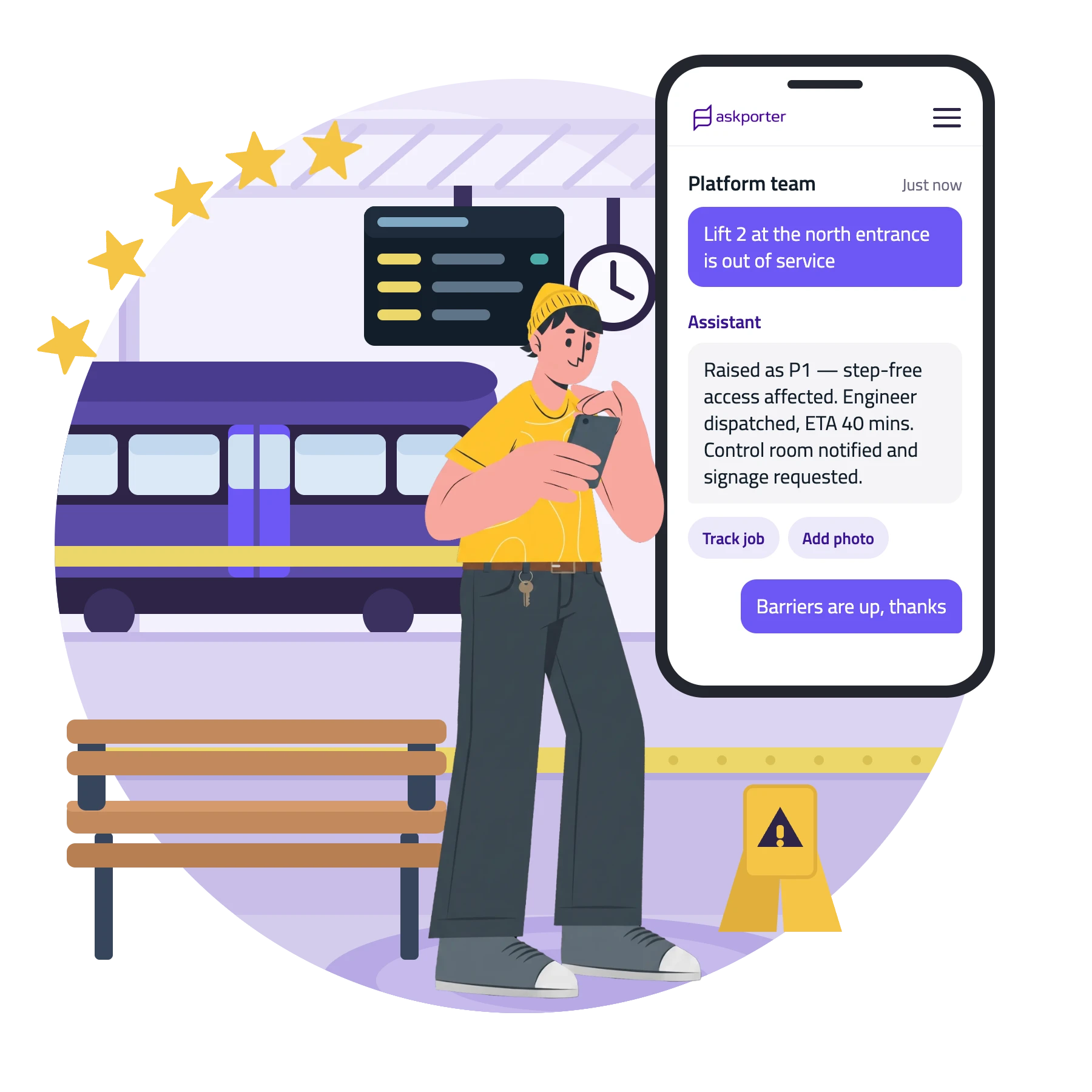
Your estate reality
You want nothing to slip in a space the public walks through. Today, you find out when someone reports it, or worse, when it becomes an incident.
A transport hub runs continuously, with heavy public footfall and safety-critical assets, lifts, escalators, barriers and lighting, that can't be allowed to sit broken. The first pain point is visibility: knowing what's wrong, where, and how urgent it is, before it's reported as an incident rather than a routine fault. The systems underneath are a specialist transport or infrastructure CAFM system, station logbooks, and a control room radio channel, none of which give one connected view.
94%
43.8%
9,000+
What askporter delivers
Four outcomes for an estates or control-room lead running a transport site.
One platform, built for all.
Built for everyone accountable for a transport site.

Station / Terminal Staff
First to spot a fault on the floor. Needs to log an issue in seconds, from wherever they're standing.
Control Room / Estates Manager
Wants visibility on progress and missed tasks in one glance, rather than chasing status across separate systems and a phone line.
Head of Airport / Train Station Operations
Signs off the budget and answers for safety and uptime under scrutiny.
Head of Safety & Assurance
Accountable for the safety-critical estate, and for evidencing that every check happened.
Simplicity is the goal.
One platform for your operations.
One platform everyone on the site already knows how to use, from station staff on the concourse to the control room.

Task Raising
Quick reporting for a hazard, a fault, or a broken asset, wherever staff are standing.
Station staff scan a QR code on a broken fitting mid-shift. Every route lands the issue in the same place, triaged and linked to the right building and asset, ready for assignment.
Multiple reporting channels: online assistant, WhatsApp, email, or a QR code at the point of the issue.
Asset & Location Intelligence: each task linked automatically to the right building, floor and asset.
Self-Help & Triage: minor issues get a suggested fix before a job is even raised.
CAFM Integration: where an enterprise CAFM or infrastructure system is already in place, tasks sync straight through.
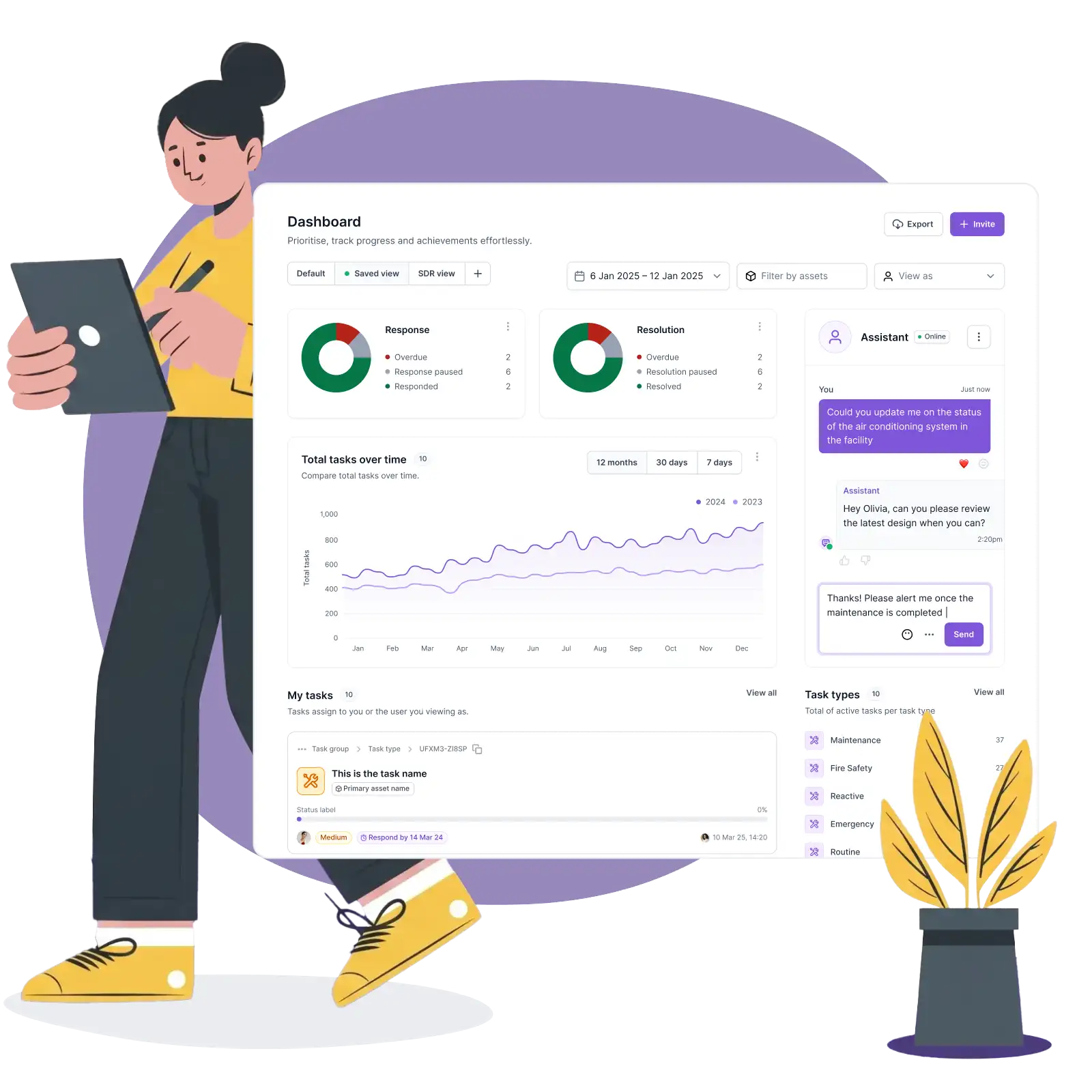
Control & Management
The at-a-glance view, with safety-critical assets prioritised.
SLAs are configured per building, per category, per team. A single dashboard shows every open, in-progress and closed job across the whole estate. When a job is heading for breach, especially on a safety-critical asset, the escalation fires automatically.
SLA Management: response and resolution targets by category, building and asset, with automatic escalation.
Task Assignment: route to the right in-house team or external contractor in one motion.
Task Management: one dashboard for every facilities job across every site.
Work Orders & Quotes: raised and approved through your rules.
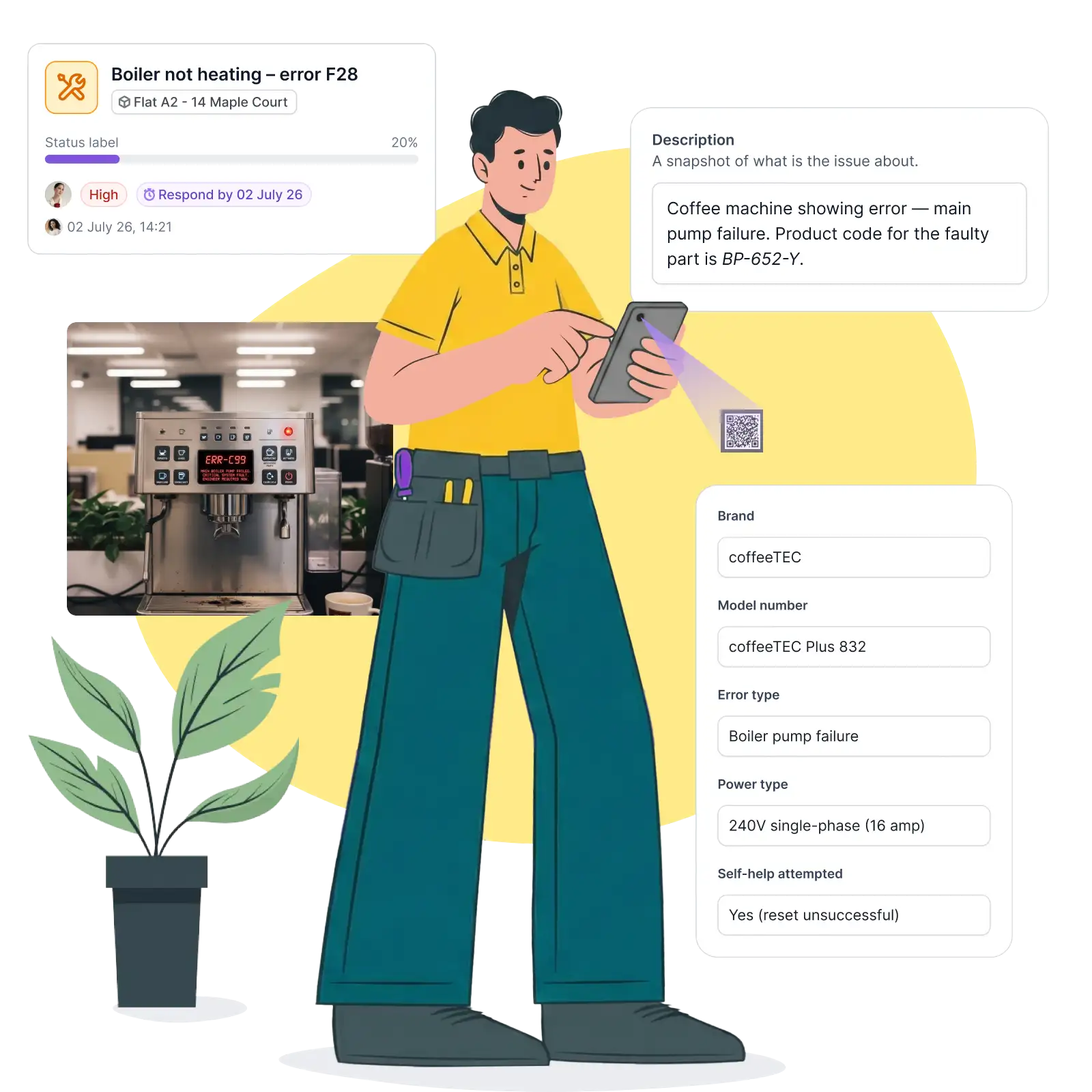
Job delivery
A walkaround or repair that leaves a record, not a logbook entry.
A maintenance or security walkaround is built from a series of stops, checked in by QR code as it's completed. Before-and-after photos attach directly to the record, so a completed check is evidenced, not just marked done in a logbook.
Operative Job Management: full job brief and asset history delivered on check-in via QR code or web link.
Photo Capture & Evidence: before-and-after photos timestamped against the job.
Supplier Assignment: assign external contractors inside the same flow as in-house teams.
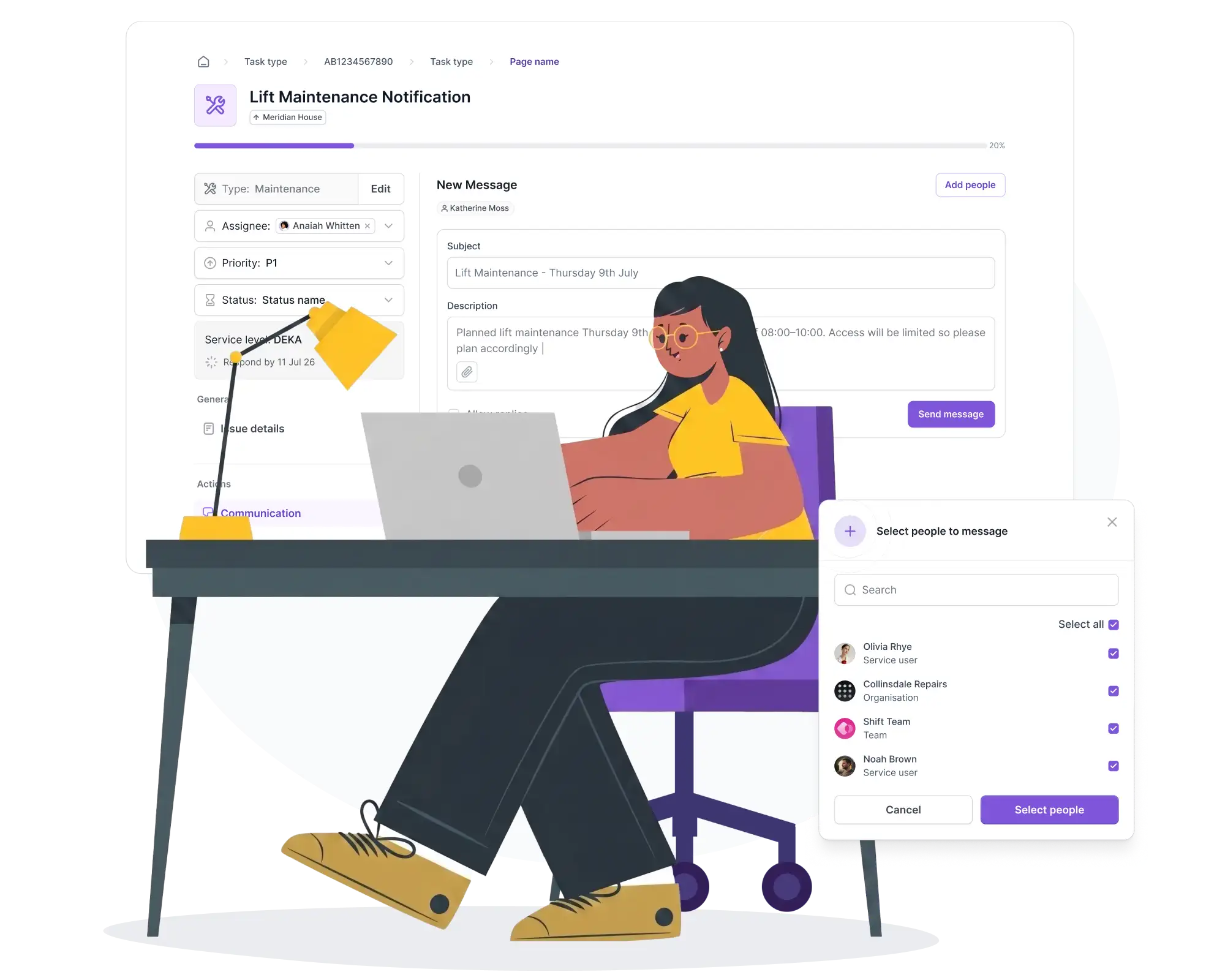
Outreach
Planned works communicated before the public notices anything's changed.
Planned maintenance and compliance campaigns go out to the right site and audience with a dated record, instead of a paper notice that may or may not get put up in time.
Planned Maintenance Notices: advance notice, with rescheduling options before the day.
Compliance & Safety Outreach: campaigns delivered by building and audience, with a full record.
Client Satisfaction Surveys: automated feedback, attributed back to building and team.
Transport hub examples
How this works across a site.
Safety-critical, fast
An escalator or lift fault, tracked with a faster SLA than routine repairs.
Because a stalled escalator or lift in a public area carries safety and accessibility risk, it's flagged as safety-critical and routed with an escalation clock that's tighter than a routine fault.
Hazard reporting
A hazard on a platform or concourse, reported in seconds.
Staff scan a QR code on a nearby panel to flag a spill, a loose tile or an obstruction, without needing to radio it in and hope someone's listening.
Clear safety records
A safety walkaround, stop by stop.
A security or maintenance walkaround covers a defined route through the site. Each checkpoint is scanned as it's reached, leaving a timestamped record rather than a logbook signature at the end of a shift.
At a glance
The shift-handover view, across every site.
Instead of a verbal handover and a logbook read-through, the incoming team sees open jobs, SLA position and anything trending toward breach on one dashboard.
See how Operations fits together across your estate.
Fifteen minutes is enough to see how every report, job and check on a transport site lands in one accountable trail.


Tech Innovation Awards 2026
Best FM & Housing AI Platform

Property Week Resi 2025
PropTech Innovation
Housing Innovation 2025
Best Repairs & Maintenance

Cyber Essentials Plus accredited
UK government-backed · externally audited

UK & EU hosted
UK data residency by default

GDPR compliant
Documented data processing · DPA on request

EU AI Act compliant
AI governance framework · 2024 legislation
Tech Innovation Awards 2026
Best FM & Housing AI Platform
Property Week Resi 2025
PropTech Innovation
Housing Innovation 2025
Best Repairs & Maintenance
Cyber Essentials Plus accredited
UK government-backed · externally audited
UK & EU hosted
UK data residency by default
GDPR compliant
Documented data processing · DPA on request
EU AI Act compliant
AI governance framework · 2024 legislation