
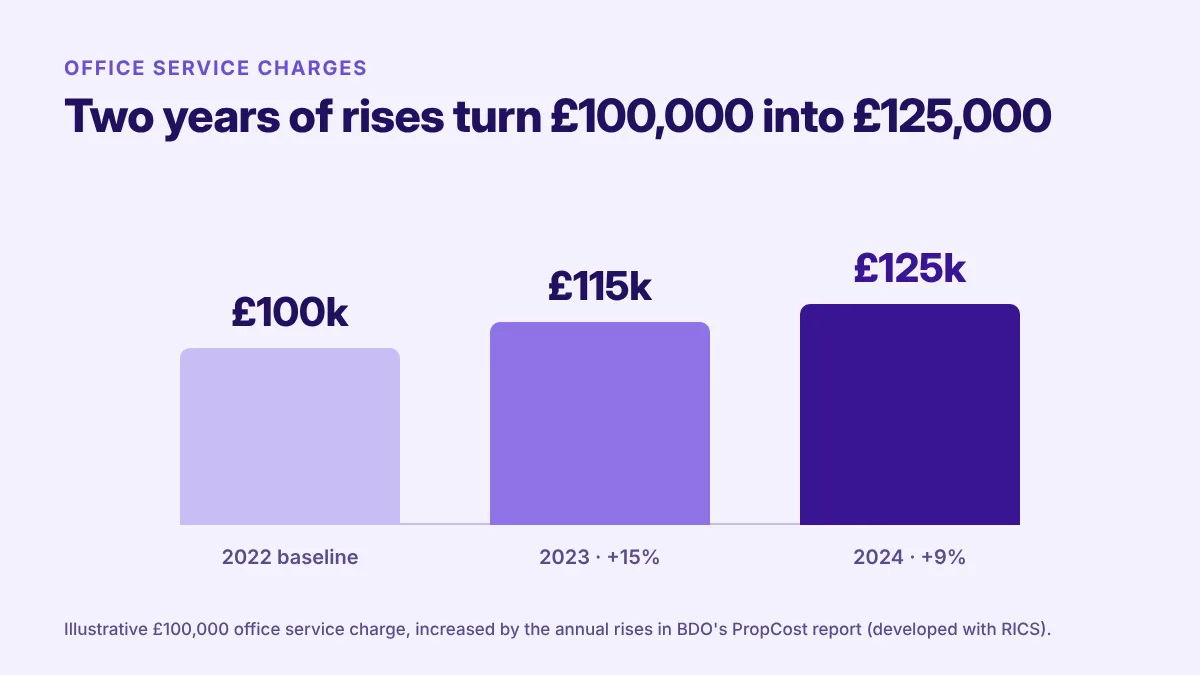
Office service charges rose 9% in 2024, on top of a 15% rise the year before. Occupiers have noticed. They're no longer asking "why did it go up?" They're asking "what exactly did we pay for?"
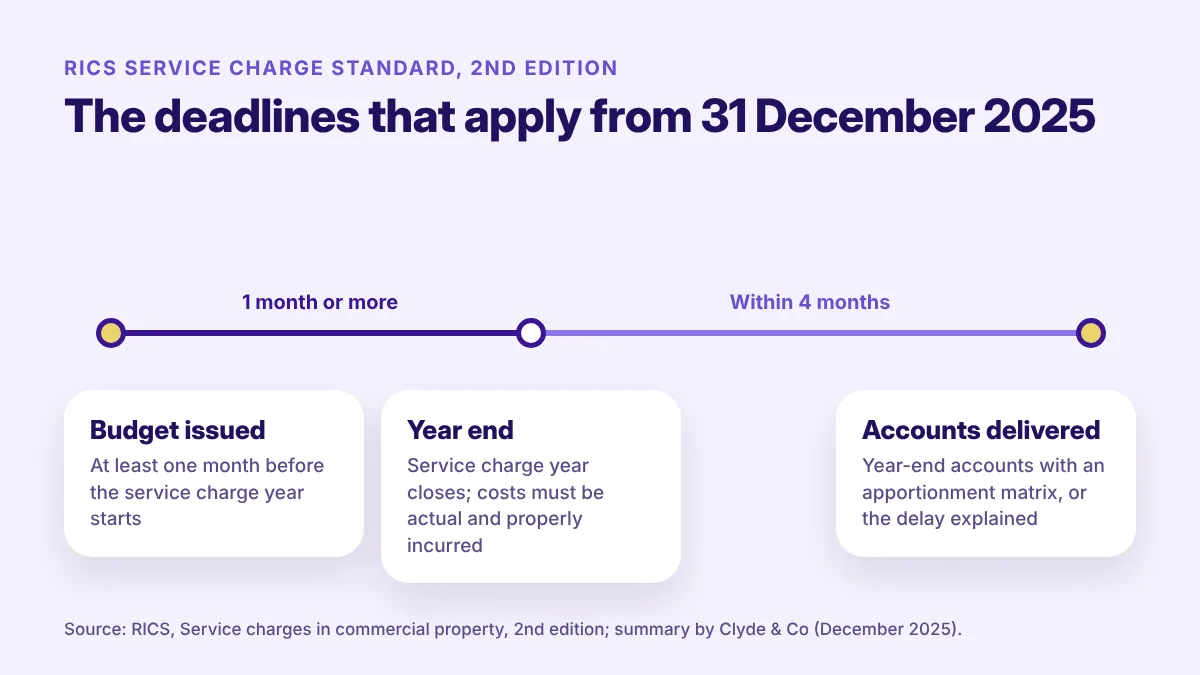
For commercial landlords, service charge transparency is now a standard to meet. The second edition of the RICS service charge standard has applied since 31 December 2025, and it is clear that only costs actually and properly incurred can be recovered. Your budget and your year-end accounts can't prove that on their own. Your job record can.
Key takeaways
Because they're paying more and can see less of where it goes. BDO's PropCost report, developed with RICS and covering more than 1,000 properties, found office service charges rose 9% in 2024 after a 15% rise the year before. Two years of steep increases have turned the service charge from a line occupiers accepted into one they scrutinise.
And that scrutiny rarely stays in the finance team. A disputed service charge follows you into the renewal meeting. It shapes the break-clause decision. It becomes the occupier's evidence for whether you run the building well.
The RICS professional standard Service charges in commercial property, 2nd edition, replaced the 2018 edition on 31 December 2025. It is mandatory for RICS members and RICS-regulated firms. It isn't law, but landlords, occupiers and their advisers treat it as the benchmark in negotiations and disputes.
Requirements that affect how you run your buildings include:
Most of these sit with finance and your surveyors. One reaches straight into operations: "properly incurred". That's a question about the work itself. Was it needed? Was it done? Was it done properly? Your accounts can't answer it. Your job record has to.
The job record is the only place that links a service charge line to the work behind it. Repairs and maintenance, cleaning and M&E lines are each built from hundreds of small jobs. The budget shows the total. Only the job record shows what that total paid for.
Picture the email. An occupier's finance director wants to know why reactive maintenance in their building rose by a fifth. If the requests came in by email, phone and at reception, contractors confirmed attendance by text, and invoices were approved because nobody could quickly match them to a visit, the answer takes days to assemble. It may never be complete.
The gap usually isn't poor service. It's a scattered record. But to an occupier who is already paying more, a scattered record looks the same as no record at all.
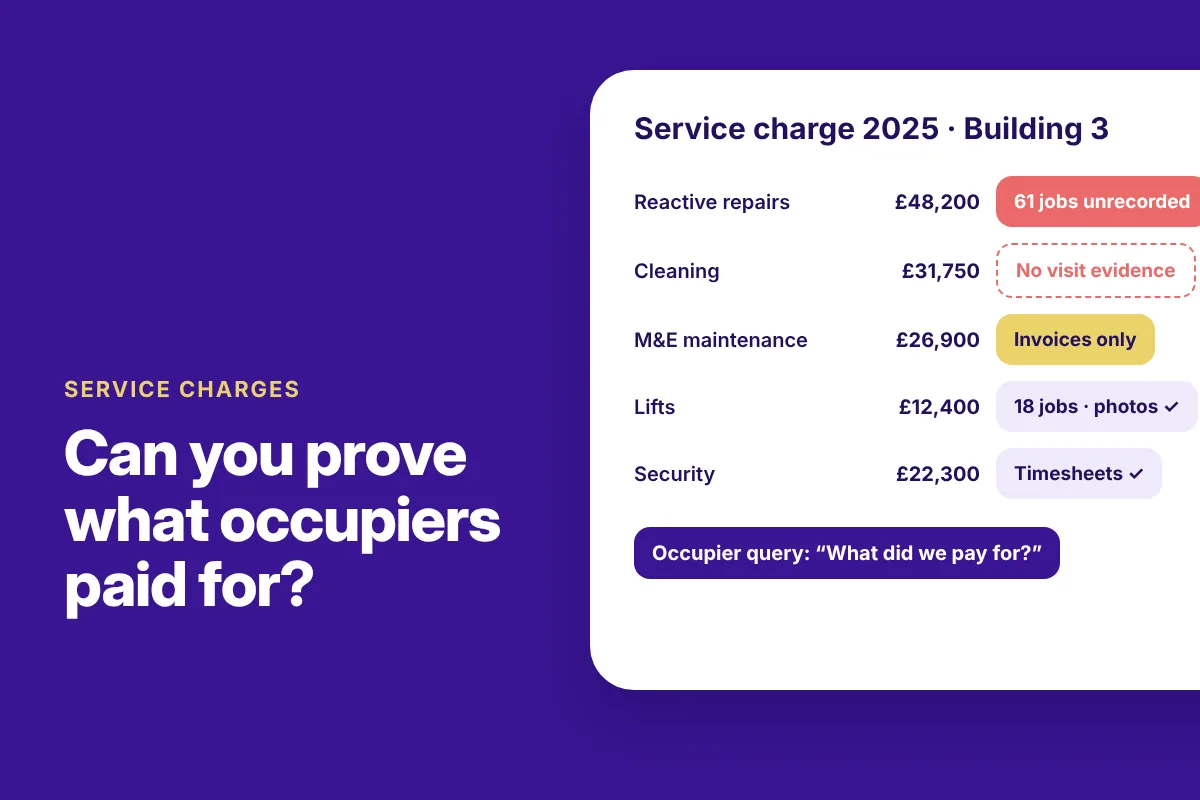
For every job behind a service charge line, you should be able to show:
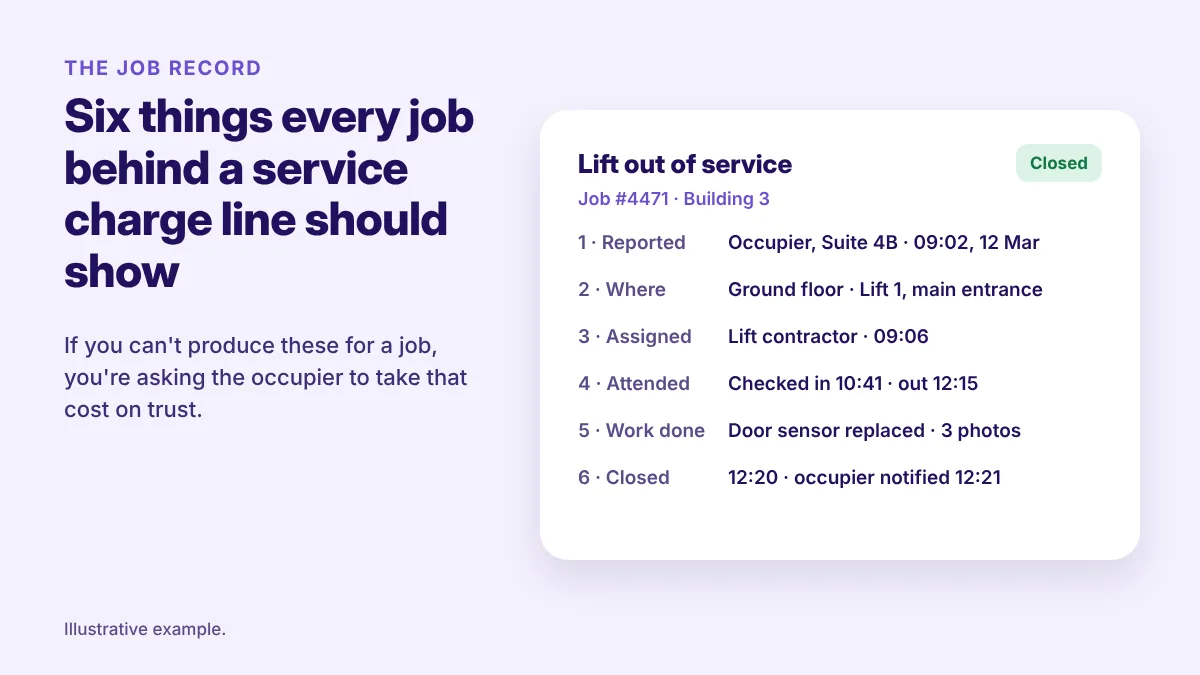
If you can't produce these six things for a job, you're asking the occupier to take that cost on trust. With charges up 9% after 15%, fewer occupiers are willing to.
Pick one building and three lines from last year's service charge: reactive repairs, cleaning and M&E. For each line, try to produce the full job record for every job behind it, and time how long it takes.
askporter Operations creates the evidence as the job runs, so nobody has to rebuild it later. Occupiers report issues through a QR code in the building, web chat, email or WhatsApp. askporter asks the right questions, gathers photos and sends a complete job to the right contractor, with no app or login for the contractor. Contractors check in and out by QR code and add photos against the job. Every request, visit and update is timestamped, building by building.
The record covers cost as well as attendance. When a job needs an external contractor, your team sends one work order to several suppliers at once. Their quotes come back into askporter side by side, lowest first, and go to the approvers you've nominated. Low-value quotes can be approved automatically when they fall within a limit you set for each asset. Every acceptance, decline, approval and rejection is logged with a reason and a date.
That matters for "properly incurred". When an occupier asks why a contractor cost what it did, you can show the quotes you received, who approved the winning one and when, and the visit that followed. The cost and the work sit on the same job record.
WISAG, the German facility services group, runs maintenance and cleaning requests through askporter: over 387,000 tasks across more than 14,200 properties and 8,400 users (as at October 2026).
When an occupier asks what they paid for, the answer is already there. Find out more about askporter for commercial landlords.
No. It isn’t law, but it is mandatory for RICS members and RICS-regulated firms, and occupiers and their advisers treat it as the benchmark of good practice.
On 31 December 2025. It replaced the first edition, published in 2018.
In broad terms, that the cost is recoverable under the lease, reasonable, and for work that was needed and actually carried out. Evidence of the work, not just the invoice, is what supports it. Take legal advice on specific disputes.
For each job: what was reported and when, where, who attended and when, what was done (with photos), and when it was closed. That record is what lets you answer an occupier challenge quickly and in full.
BDO's PropCost report found office service charges rose 9% in 2024, after a 15% rise the year before.
This article is general information, not legal advice.

Best FM & Housing AI Platform

PropTech Innovation

Best Repairs & Maintenance

UK government-backed · externally audited

UK data residency by default

Documented data processing · DPA on request

AI governance framework · 2024 legislation
Best FM & Housing AI Platform
PropTech Innovation
Best Repairs & Maintenance
UK government-backed · externally audited
UK data residency by default
Documented data processing · DPA on request
AI governance framework · 2024 legislation