
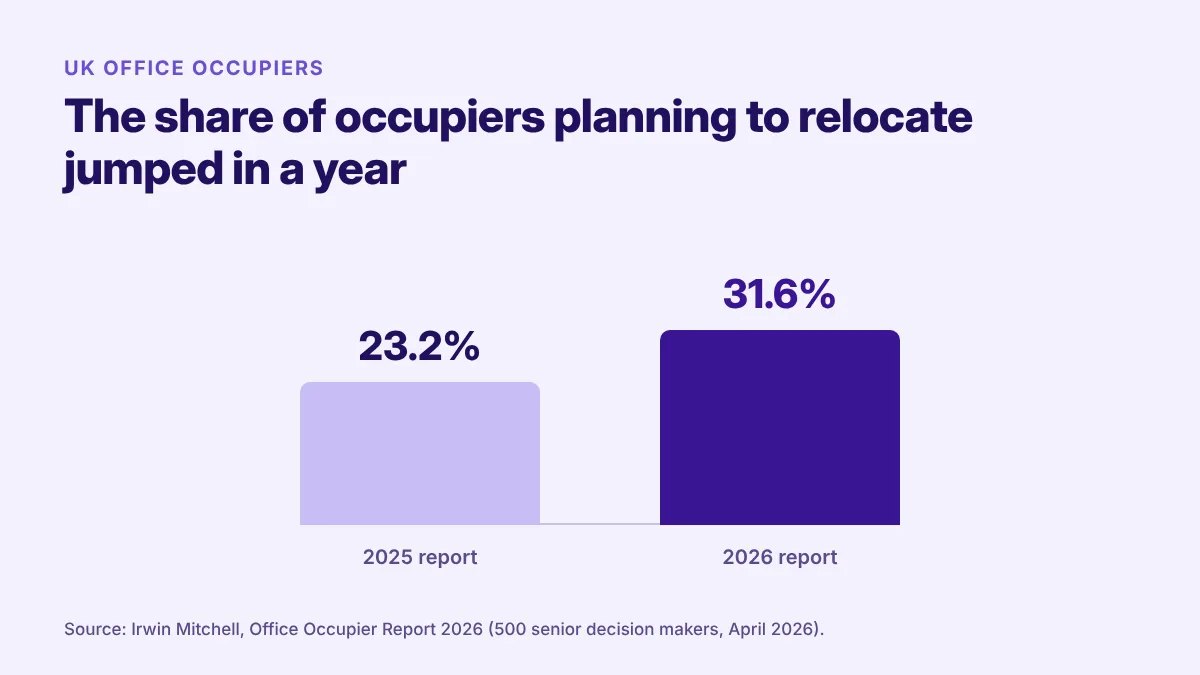
Nearly a third of UK office occupiers plan to move. Irwin Mitchell's 2026 Office Occupier Report found that 31.6% of 500 senior decision makers intend to relocate, up from 23.2% a year earlier. For commercial landlords with their own property management teams, each of those is a lease renewal that could go either way.
The decision to leave rarely starts at the break clause. It starts with the leak that took a week, the heating that failed twice in January, and the third email asking for an update. By the time the occupier's agent calls, their view of your building and its management may already be formed.
Key takeaways
Rent, space and location decide the shortlist. But occupiers also judge a building on how it's run day to day: how easy it is to report a problem, how quickly it's fixed, and whether anyone tells them what's happening. When the lease comes up, that experience weighs on the decision to stay or go.
Most occupiers rarely see your asset plan or your plant room. They see their requests. Every slow fix and unanswered email becomes part of the story they tell themselves about your building, and it's the story they bring to the renewal table.
The flight to quality is occupiers moving to better buildings when their lease ends. In Savills' March 2026 survey of regional office agents, 65% expected take-up of prime space to rise, while 74% expected demand for Grade B space to stay flat or fall. The gap between the best buildings and the rest is widening.

If you own Grade B space, that changes every renewal. Your occupier isn't just deciding whether to stay. They're comparing your building with newer space down the road, and they've probably been shown round it.
You can't refurbish every building before every lease event. You can make sure the building they're in works, and that they can see it works.
Because occupiers are paying more for it. BDO's PropCost report found office service charges rose 9% in 2024, after 15% the year before. When the bill goes up and the response to a broken lift doesn't improve, the gap is hard to ignore, and easy to raise at renewal.
Three moments shape how an occupier feels about service:

Get these three right and service becomes a reason to stay. Get them wrong and every rise in the service charge becomes a reason to go.
Four changes make the most difference to how occupiers experience a building. None needs capital spend. They change how requests are handled, not the fabric of the building.
A QR code in the lobby, web chat, email or WhatsApp. Every new app or login puts another step between the problem and your team, and few occupiers will download a building app to report a dripping tap.
What's wrong, where it is, how urgent it is, and a photo. A complete request means the right contractor attends once, instead of one visit to diagnose and another to fix.
A short update when the job is booked, when the contractor is on the way and when it's done. Every "any update?" email you prevent is one less thing for your team to answer, and one less frustration for the occupier to remember.
When a lease event comes up, you should be able to see every request that occupier made, how long each took and what was done. That turns the renewal conversation from anecdotes into facts. The same record answers occupier questions about the service charge.
Look at their service history, not just the lease schedule. Well before a break or expiry date (ideally a year out), check for warning signs:

Each of these is something you can still fix. Found a year out, they're a to-do list. Found at the renewal meeting, they're the reason the occupier gives for leaving.
askporter Operations takes every occupier request from first message to closed job. Occupiers report through a QR code, web chat, email or WhatsApp. askporter asks the right questions, gathers photos and sends a complete job to the right contractor, with no app or login for the contractor.
When a job needs an external contractor, your team can send one work order to several suppliers at once. Their quotes come back into askporter side by side, lowest first, and go straight to the people you've nominated to approve them. Low-value quotes can be approved automatically when they fall within a limit you set for each asset. Every acceptance, decline, approval and rejection is logged with a reason, so the decision behind each cost is on record.
For occupiers, that means less time waiting while quotes go back and forth by email. For your team, it means every contractor cost behind the service charge has a quote, an approver and a date against it.
Each visit is timestamped with photos against the job, so your team can see what was done and when without picking up the phone. And before a lease event, you can see every request that occupier made, in one place.
WISAG, the German facility services group, runs maintenance and cleaning requests through askporter: over 387,000 tasks across more than 14,200 properties and 8,400 users (as at October 2026).
If a lease event is coming up in your portfolio, we can show you how it would work in one of your buildings. Find out more about askporter for commercial landlords.
31.6% of UK office occupiers plan to relocate, up from 23.2% a year earlier, according to Irwin Mitchell's 2026 Office Occupier Report, based on 500 senior decision makers.
It's occupiers moving to higher-quality buildings when their lease ends. Savills' March 2026 survey found 65% of regional office agents expect prime take-up to rise, while 74% expect Grade B demand to stay flat or fall.
Service is the part of an occupier's experience you can change quickly and without capital spend. It won't outweigh rent or location on its own, but slow fixes and poor communication give occupiers a reason to look elsewhere.
Well before the break or expiry date. Reviewing an occupier's service history a year out gives you time to fix recurring issues before they shape the decision.

Best FM & Housing AI Platform

PropTech Innovation

Best Repairs & Maintenance

UK government-backed · externally audited

UK data residency by default

Documented data processing · DPA on request

AI governance framework · 2024 legislation
Best FM & Housing AI Platform
PropTech Innovation
Best Repairs & Maintenance
UK government-backed · externally audited
UK data residency by default
Documented data processing · DPA on request
AI governance framework · 2024 legislation